Academics
Faculty of Global Informatics

The Faculty of Global Informatics was established in April 2019, under the leading concept of integrating the study of “Information Technology” and “Law.” Today, we live in a world surrounded by various information technology. People of all generations use smartphones, and an increasing number of people rely primarily on social networking services to obtain information. Cloud-based services have become indispensable for businesses.
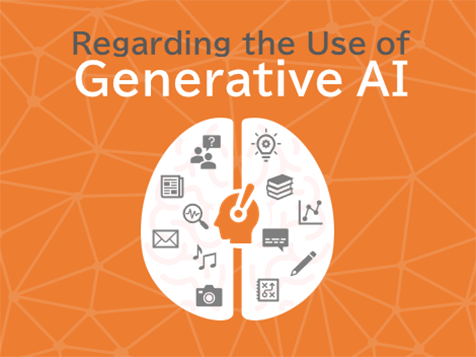
Furthermore, generative AI has rapidly permeated society, accelerating global competition in technological development. You may find it difficult to foresee the future as new technologies continue to emerge. In such an era, the knowledge and ability to understand and appropriately utilize both “Information Technology,” which explores what can be achieved through IT, and “Law,” which examines what is permissible or should be regulated, have become more important than ever. For instance, generative AI is utilized in many scenes and encompasses various types: Conversational AI, AI Summarizer, AI Image Generator, AI Video Generator, AI Voice Generator, and AI Code Generator. In addition, these functions require a tremendous amount of collected data in order to create learning models. The thing is, what if the AI collected data contains copyrighted works, personal information, or trade secrets? You may face a legal problem. Furthermore, what if the learning model is biased? There is a high risk that the AI-generated answers are inappropriate or inaccurate. A sound knowledge of information technology is therefore essential to accurately grasp how new digital services operate and what types of data they collect. Equally important is knowledge of information law, which enables us to examine whether handling practices are legally compliant or whether new legislation is necessary to address legal shortcomings. People must cultivate the ability to use generated AI correctly without being overly dependent on it or unduly influenced by it.
The Faculty of Global Informatics offers students opportunities to study “Information Technology” and “Law,” contributing to fostering the ability to thrive in this turbulent society. We are also known as “iTL,” a term that combines IT and Law. In addition, iTL also stands for the “Ichigaya Tamachi Link” referring to the Ichigaya Tamachi campus, our home campus, which symbolizes our mission to link people and society. We are delighted to introduce the name “iTL,” and hope it soon becomes familiar to all.
Furthermore, beyond our two core pillars of IT and Law, the Faculty of Global Informatics emphasizes “global liberal arts” as our third pillar. A global liberal arts foundation is indispensable for students to accurately identify complex situations caused by the rapid circulation of massive information worldwide, phenomena that can lead both to sparking innovation and multiple social challenges. The education enables students to discern the best direction for a society. In that sense, one of the important fields of study is English, a universal language that facilitates international communication. Recently, people have been enjoying AI-powered translation tools as their convenient supporters. Maybe you find it difficult to utilize English because you are accustomed to communicating primarily in Japanese. However, enhancing your English proficiency and becoming a fluent English speaker will allow you to play an active role on the global scene, and such experience will significantly broaden your worldview. Another essential learning is the liberal arts, which fosters mutual understanding among diverse cultures. True intercultural understanding requires a deep awareness of different cultures beyond English proficiency. The Faculty of Global Informatics offers you curricula that broaden your perspectives, including courses in philosophy, ethics, social psychology, international culture theory, and comparative study of civilization theory.
The graduates of the Faculty of Global Informatics are playing active roles in society by expanding their professional fields of development. They are engaged in leading think tanks, various domestic and international IT companies, top financial institutions, broadcasting organizations, government agencies, national research institutions, graduate schools, and more. If you are interested in our three core pillars of study, “Information Technology,” “Law,” and “Global Liberal Arts,” and willing to study with motivation and awareness, we warmly welcome you to join us at the Ichigaya Tamachi campus.
Kaori ISHII
Dean, Faculty of Global Informatics