
2026.06.09
News
Research Paper by Kana Matsumoto (Master-course Student) and Professor Kenji Katayama (Department of Applied Chemistry, Graduate School of Science and Engineering) Selected for the Front Cover of a Royal Society of Chemistry Journal
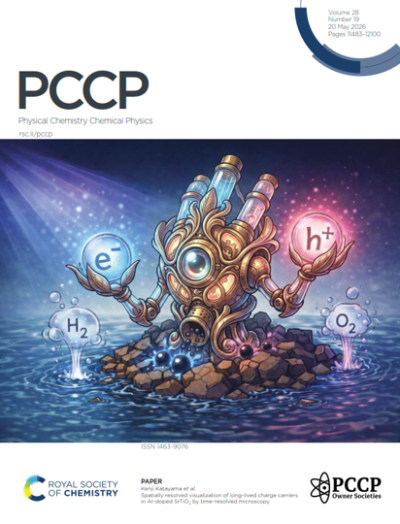
Journal Cover Page
Visualization of Long-Lived Charge Carriers in Al-Doped SrTiO₃ via PI-PM Method
—Direct Elucidation of the Mechanism for High-Efficiency Photocatalytic Water Splitting via Microscopic Imaging, Featured on the Front Cover of Physical Chemistry Chemical Physics—
A collaborative research team consisting of the Katayama group at Department of Applied Chemistry, Chuo University (including Kana Matsumoto and Yuki Nakatsukasa), the Pan group, University of Hyogo (Associate Professor Zhenhua Pan and Daisuke Ioka), and the Sohn group at Chungbuk National University (Seung Heon Choi and Professor Woon Yong Sohn) has successfully visualized for the first time the microscopic origin of the enhanced efficiency in photocatalytic water splitting using aluminum-doped strontium titanate (SrTiO₃:Al). This breakthrough was achieved utilizing a uniquely developed Pattern-Illumination Time-Resolved Phase Microscopy (PI-PM) method. These findings were published in the international scientific journal Physical Chemistry Chemical Physics (published by the Royal Society of Chemistry), Volume 28, Issue 19 (May 20, 2026), and were selected to feature on the front cover.
Research Background
Photocatalytic water splitting holds great promise as a renewable energy technology capable of directly producing hydrogen from sunlight. Among various materials, aluminum-doped strontium titanate SrTiO₃(SrTiO₃:Al) is a world-class photocatalytic material that has demonstrated an apparent quantum yield approaching nearly 100% under ultraviolet (UV) illumination. It has long been believed that the key to this outstanding performance lies in the ability of photo-excited electrons and holes to survive for extended lifetimes without recombination. However, conventional spectroscopy techniques could not provide microscopic spatial information regarding where and in what manner these charge carriers are accumulated and separated. Consequently, this precise mechanism had remained an unsolved mystery for many years.
Research Approach and Achievements
In this study, the research team directly imaged the spatiotemporal dynamics of electrons and holes in thin films of SrTiO₃, SrTiO₃:Al and Rh-loaded SrTiO₃:Al particles in the time range from nanosecond-to-millisecond and with microscopic spatial resolution, utilizing the PI-PM (Pattern-Illumination Time-Resolved Phase Microscopy) method independently developed by the Katayama group.
The PI-PM method detects changes in the refractive index caused by photo-generated charge carriers using a phase-contrast microscope. Because electrons and holes induce opposite signs of refractive index changes, this technique makes it possible to spatially distinguish which type of carrier is accumulating in specific regions.
By combining this method with clustering analysis, the team uncovered the following three major insights:
1. Dramatic Extension of Hole Lifetime via Al-Doping
The team directly confirmed that Al-doping creates new hole-trap states, extending the lifetime of holes by more than two orders of magnitude compared to the original recombination pathways within the bands. Since these long-lived holes were selectively quenched by hole scavengers, they were proven to be the active species contributing to the water oxidation reaction.
2. Suppression of Fast Recombination Pathways Derived from Ti³⁺ Defects
In pristine SrTiO₃ prior to Al-doping, a symmetrical trap response of electrons and holes originating from Ti³⁺ defects was observed. The spatial visualization revealed that Al-doping decreases this fast recombination component, allowing charge carriers to separate effectively.
3. Formation of Electron Accumulation Sites by Rh Cocatalysts
The introduction of Rh revealed an additional delayed electron response, which was subsequently quenched by electron scavengers. Spatiotemporal resolved imaging directly demonstrated for the first time that Rh functions as a storage site for photogenerated electrons, thereby accelerating the water reduction reaction.
These experimental results were quantitatively reproduced by numerical simulations based on rate equations, leading to the establishment of a consistent carrier dynamics model incorporating Al-induced hole traps and Rh-induced electron traps.
About the Cover Illustration
The artwork featured on the front cover of this issue anthropomorphizes the electron/hole separation process into a "chemical monster." In this imaginative visualization, the Al-doping forms the skeleton of the monster, while the cocatalysts are depicted as breathing out the flames of hydrogen and oxygen evolution. This sophisticated illustration was brought to life by taking a rough sketch drawn by the research team members and refining it using Gemini.
Significance of the Research
This study directly demonstrates for the first time that the two core mechanisms underlying the high photocatalytic activity of SrTiO₃:Al (the suppression of Ti³⁺ defects and the formation of long-lived hole traps) are distributed spatially heterogeneously across the particle surfaces. It also demonstrates that the PI-PM method is a powerful tool for analyzing local carrier dynamics in particulate photocatalysts, and offers important design guidelines for next-generation photocatalytic materials from the perspective of the localization and control of long-lived charge carriers.
Journal: Physical Chemistry Chemical Physics (RSC)
Kana Matsumoto, Yuki Nakatsukasa, Daisuke Ioka, Zhenhua Pan, Seung Heon Choi, Woon Yong Sohn, Kenji Katayama
Spatially Resolved Visualization of Long-Lived Charge Carriers in Al-Doped SrTiO₃ by Time-Resolved Microscopy
Phys. Chem. Chem. Phys., 2026, 28, 11587–11599
DOI: 10.1039/D6CP00521G
Front Cover: DOI: 10.1039/D6CP90094A
Reference
Spectroscopy and Photochemistry System Laboratory (Katayama Group)

