
2026.04.30
News
Development of "MIROC6-iso": A Climate Model for Tracing the History of the Water Cycle Through Isotopes in Precipitation, Water Vapor, and Seawater - Improved Reproducibility of Interannual Variability Enables Climate Reconstruction for Regions and Periods Without Observational Data -
Note: This press release is a joint announcement by Chuo University, Chiba University, and The University of Tokyo.
・Researchers have developed Japan's first global water-isotope climate model that couples the atmosphere, land, ocean, and sea ice.
・Simulations covering 1850-2014 consistently reproduce observed isotope ratios in precipitation, water vapor, and seawater, as well as their relationships with temperature or salinity.
・By accounting for atmosphere-ocean interactions, the model improves the reproducibility of the spatial distribution of oxygen isotope ratios in Pacific surface seawater (δ18Osw) and the interannual variability associated with El Niño and La Niña events, demonstrating the importance of vertical mixing and horizontal advection.
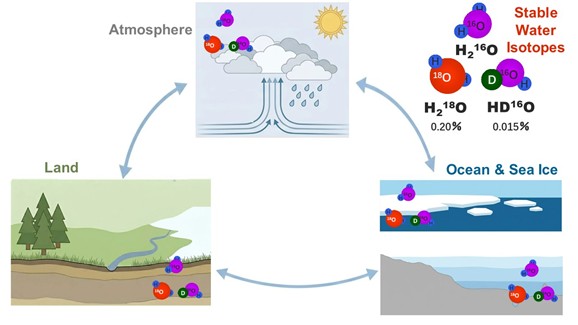
Schematic diagram showing the cycling of stable water isotopes (H₂¹⁸O and HDO) among the atmosphere, land, and ocean
Overview
A collaborative research group consisting of Assistant Professor Yifan Li (Chuo University), Associate Professor Atsushi Okazaki (Center for Environmental Remote Sensing, Chiba University), Project Assistant Professor Alexandre Cauquoin, and Professor Kei Yoshimura (Institute of Industrial Science, The University of Tokyo) has developed MIROC6-iso by incorporating water isotopes*1 into the MIROC6 climate model*2. MIROC6-iso is Japan's first water-isotope climate model that couples the atmosphere, land, ocean, and sea ice.
Water isotopes are water molecules that contain small amounts of heavy isotopes naturally present in Earth's water. Because they are gradually fractionated during processes such as evaporation and condensation, they can be used as natural tracers that record the history of the water cycle.
In this study, the research team compared simulations for the period from the industrial era to the recent period (1850-2014) with observations, focusing on isotope ratios in precipitation, water vapor, and seawater, as well as the relationship between seawater isotope ratios and salinity. The results confirmed that the newly developed climate model can reproduce the global water cycle in a physically consistent manner. Focusing on the Pacific Ocean, the team further compared a fully coupled configuration that calculates the three-dimensional ocean with a conventional configuration that considers only vertical mixing in the surface layer. This comparison showed that resolving both vertical mixing and horizontal advection in the ocean is important for improving the reproducibility of seawater isotope ratios (Fig. 1). These results provide a foundation for interpreting natural proxy records, such as isotope ratios in coral skeletons and ice cores, that are used to reconstruct climate in regions and periods without direct human observations. The model is expected to contribute not only to understanding the mechanisms of past and present climate variability and change, but also to improving projections of future changes in climate and the water cycle.
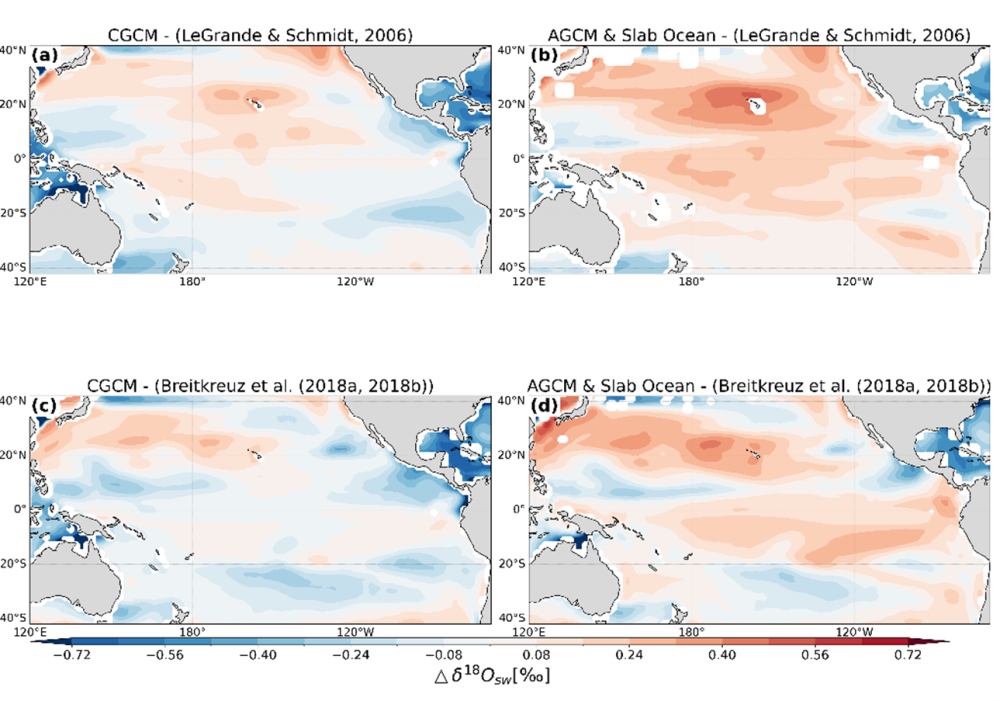
Fig. 1: Comparison of model reproducibility for δ18Osw in the Pacific Ocean.
(a, c; two panels on the left): Differences between the new water-isotope climate model (MIROC6-iso), which couples the atmosphere, land, ocean, and sea ice, and quasi-observational data.
(b, d; two panels on the right): Differences between the conventional model, which considers only surface-layer vertical mixing, and quasi-observational data. Lighter red and blue shading indicates smaller errors, showing that the new atmosphere-ocean coupled model achieves higher reproducibility.
Research Team
Yifan Li
Assistant Professor, Faculty of Science and Engineering, Chuo University
Atsushi Okazaki
Associate Professor, Center for Environmental Remote Sensing, Chiba University
Alexandre Cauquoin
Project Assistant Professor, Institute of Industrial Science, The University of Tokyo
Kei Yoshimura
Professor, Institute of Industrial Science, The University of Tokyo
Publication Information
Journal: Journal of Advances in Modeling Earth Systems
Title: Improved Response of δ18Osw in the Pacific Ocean to Atmosphere-Ocean Interaction and ENSO Using the Isotope-Enabled Fully Coupled Model MIROC6-iso (Published April 7, 2026)
Authors: Yifan Li, Alexandre Cauquoin, Atsushi Okazaki, Kei Yoshimura
DOI: 10.1029/2025MS005082
Research Content
1. Background
As global warming and the associated increase in extreme events attract growing attention, it is socially important to project future climate and water-cycle changes with high accuracy. From this perspective, understanding the mechanisms of past climate variability has also become increasingly important. Climate models developed by leading research institutions around the world calculate interactions among the atmosphere, ocean, land surface, and cryosphere based on physical laws. The water cycle represented in these climate models is fundamental to the climate system itself and is also critically important for human society and ecosystems. However, because the water cycle involves phase changes such as precipitation and evaporation, it is difficult to distinguish its underlying mechanisms from observations of water quantity alone. Water isotopes, which can be regarded as an "invisible color" of water, provide clues to the origin and transport pathways of water and therefore make it possible to trace the water cycle.
Water isotopes are water molecules that contain heavy stable isotopes of hydrogen and oxygen, such as deuterium and oxygen-18. They are present in small but ubiquitous amounts in all forms of water on Earth. During phase changes such as evaporation and condensation, molecules containing heavier isotopes are fractionated slightly. This property is known as fractionation, or isotope fractionation. As a result, the isotope ratios of precipitation, water vapor, and seawater reflect where water originated and how it moved and mixed. In addition, isotope information preserved in ice cores, speleothems, corals, and marine sediments remains stable after it is fixed and has therefore been widely used as climate proxies, or indirect climate information, for interpreting climate variability in regions and periods without human observations.
When water isotopes are incorporated into a climate model, isotopes are exchanged among the atmosphere, ocean, land surface, and cryosphere. In addition to conventional variables calculated by climate models, such as precipitation amount, atmospheric water vapor, and ocean water content, isotope ratios in precipitation, water vapor, and seawater can also be simulated. Atmospheric, oceanic, and land-surface models that include water isotopes have previously been run as separate models, but in such models, conditions outside the target domain have generally been prescribed as boundary conditions, such as sea surface temperature in atmospheric models or lower-atmospheric conditions in ocean models. This treatment can make it difficult to ensure accuracy when reconstructing past climates and can become a source of uncertainty. In contrast, an atmosphere-ocean coupled climate model that includes water isotopes, such as the one developed in this study, has the advantage of treating boundary conditions such as sea surface temperature and seawater isotope ratios as dynamically as possible rather than fixing them. This makes the model useful not only for paleoclimate reconstruction through the interpretation of climate proxies, but also for understanding the mechanisms of ongoing climate change and global warming and for improving future projections.
2. Research Content and Outcomes
In this study, the research team incorporated water isotopes into MIROC6, a sixth-generation coupled atmosphere-ocean model developed in Japan, and developed MIROC6-iso, Japan's first water-isotope climate model that couples the atmosphere, land, ocean, and sea ice. First, simulations for the period from the industrial era to the recent period (1850-2014) confirmed that the spatial distributions of isotope ratios in precipitation, water vapor, and seawater, as well as the relationships between these isotope ratios and temperature or salinity, are consistent with observations. For example, the global distribution of precipitation isotope ratios (δ18Op) showed good agreement with observations from GNIP stations, ice cores, and speleothem records (Figs. 2a, b). The model also reproduced with high accuracy the observed spatial relationship between δ18Op and air temperature (Fig. 2c), demonstrating that the climate responses represented through water isotopes are physically reasonable. For seawater isotope ratios (δ18Osw), the model showed high consistency with existing global observational and quasi-observational datasets for both surface distributions and vertical structure (Fig. 3). In addition, the vertical structure in the Pacific and Atlantic Oceans was reproduced consistently from the surface to the deep ocean, confirming that water and isotope transport processes in the ocean interior, including advection, mixing, and diffusion, are appropriately represented.
Such large-scale simulations require substantial computational resources. This study used the Earth Simulator, a supercomputer operated by JAMSTEC. By revising the exchange processes for freshwater fluxes and water-isotope fluxes among the atmosphere, land surface, ocean, and sea ice components, the research team confirmed that mass conservation is strictly satisfied across the entire coupled system. Improvements in computational stability and efficiency also made these simulations possible.
Next, the team focused on the Pacific Ocean and compared two computational configurations. The first was a fully coupled configuration in which the ocean is calculated in three dimensions. The second was a conventional configuration that considers only vertical mixing in the surface layer. The comparison showed that the fully coupled configuration reproduces not only the long-term mean values of surface seawater isotope ratios but also the magnitude and spatial structure of their interannual variability more appropriately than the conventional configuration. In the conventional configuration, by contrast, ocean-interior transport is not represented, so the influence of the surface freshwater balance tends to be overemphasized and temporal variability in seawater isotope ratios can be overestimated in some regions. A budget analysis of both water amount and isotope composition further showed that the main reasons for the improved reproducibility in the fully coupled configuration are the explicit representation of vertical mixing in the ocean interior and horizontal advection in the zonal and meridional directions.
3. Future Perspectives
MIROC6-iso explicitly simulates isotopes in precipitation, water vapor, and seawater. Because it does not require assumed distributions as boundary conditions, the model can calculate water-isotope information for a wide range of regions and time periods around the world. One major advantage is that the mechanisms of the water cycle within the model can be examined even for regions and periods without observations. For example, MIROC6-iso can be used for paleoclimate reconstructions based on climate proxies such as ice cores, speleothems, corals, and marine sediments, and for evaluating uncertainties in the interpretation of these proxies. It can also be used to improve understanding of the water cycle associated with present-day interannual variability, including El Niño and La Niña events, polar modes of variability, and fluctuations linked to the Asian monsoon. Furthermore, it is expected to support the development and improvement of models for better projections of water-cycle changes and extreme precipitation under future climate scenarios.
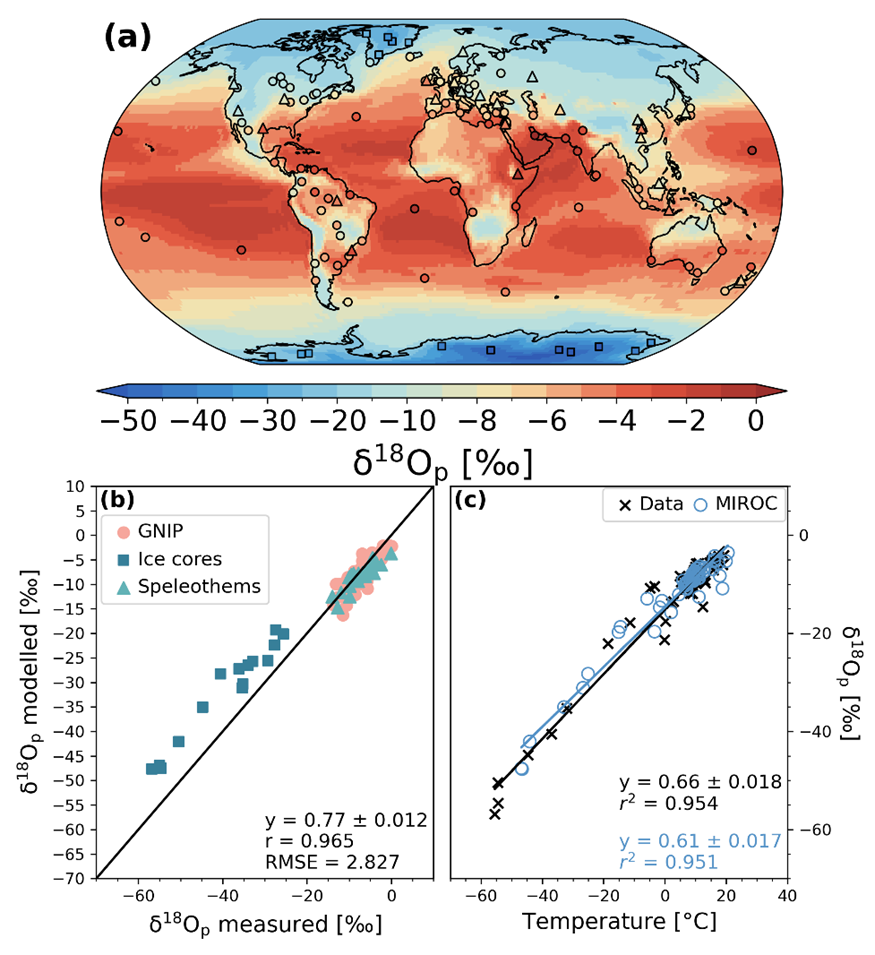
Fig. 2: Evaluation of the reproducibility of precipitation isotope ratios (δ18Op) in MIROC6-iso
(a) Comparison of the global distribution of annual mean δ18Op (background) with observed values from GNIP sites, ice cores, and speleothems
(b) Scatter plot comparing model results with observational data
(c) Comparison of regressions for the spatial relationship between δ18Op and surface air temperature
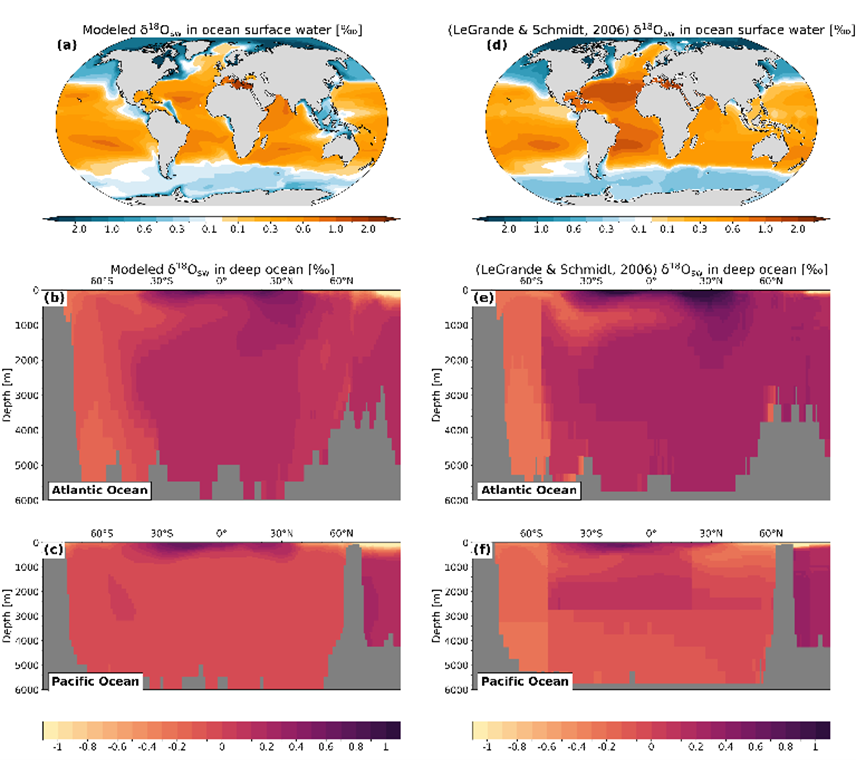
Fig. 3: Comparison of the surface distribution and vertical structure of seawater isotope ratios (δ18Osw)
(a, d) Surface δ18Osw simulated by MIROC6-iso and observation data
(b, c, e, f) Comparison of annual-mean vertical distributions in the Atlantic and Pacific Oceans between the model and quasi-observational data
Related Information
Press Release 1: "Changing Weather Forecasting with Heavy Water Vapor Observed from Space" (September 14, 2021)
https://www.iis.u-tokyo.ac.jp/ja/news/3652/
Press Release 2: "Clarifying the Origin and History of the Water Vapor that Caused the July 2020 Kumamoto Heavy Rainfall: A New Picture of Linear Rainbands Revealed Through Isotope Ratios in Precipitation" (announced by Kyushu University; March 10, 2023)
https://www.iis.u-tokyo.ac.jp/ja/news/4147/
Press Release 3: "High-Resolution Simulation for Tracking the Atmospheric Water Cycle: Development of a Next-Generation Water-Isotope Atmospheric General Circulation Model" (announced by the National Institute for Environmental Studies; December 7, 2023)
https://www.iis.u-tokyo.ac.jp/ja/news/4382/
Press Release 4: "Predicting the Concentration Distribution of Tritium Released from the Fukushima Daiichi Nuclear Power Station Using a Global Ocean Model: Latest Simulation Results Based on the Release Plan" (July 2, 2025)
https://www.iis.u-tokyo.ac.jp/ja/news/4809/
Press Release 5: "Precisely Visualizing Earth's Water Cycle Using Water Isotopes: The World's First Standardized Analysis by the International Model Intercomparison Project WisoMIP" (February 12, 2026)
https://www.iis.u-tokyo.ac.jp/ja/news/4990/
Funding for the Research Underlying This Study
JSPS Grants-in-Aid for Scientific Research (KAKENHI): JP22H04938 and JP21H05002
JST-Mirai Program: JPMJMI24I1
JST e-ASIA Joint Research Program: JPMJSC22E4
MEXT Program for Advanced Studies in Climate Change Projection (SENTAN): JPMXD0722680395
MEXT Arctic Challenge for Sustainability III (ArCS-3): JPMXD1720251001
Environmental Research and Technology Development Fund (S-20), Environmental Restoration and Conservation Agency of Japan: JPMEERF21S12020
Japan Aerospace Exploration Agency (JAXA): JX-PSPC-565307
and other research grants
Glossary
*1) Water Isotopes
Water molecules that contain heavy isotopes of hydrogen or oxygen, such as ²H (deuterium) or ¹⁸O (oxygen-18). During phase changes of water, such as evaporation and condensation, molecules containing heavier isotopes are preferentially partitioned toward the liquid phase relative to the vapor phase and toward the solid phase relative to the liquid phase. This property, known as isotope fractionation, makes water isotopes useful indicators of water-cycle processes on Earth that involve phase changes.
*2) Climate Model
A computer program that numerically represents the state of the Earth's atmosphere, ocean, land surface, and cryosphere, as well as their interactions, based on physical laws such as dynamics, thermodynamics, and radiation. Climate models are used, together with validation against observational data, to understand past climate variability and to project future climate under assumed scenarios such as greenhouse gas concentrations and land-use changes. Because physical processes and representation methods differ among models, several dozen climate models have been developed worldwide.
< Research Contacts >
Yifan Li
Assistant Professor, Faculty of Science and Engineering, Chuo University
E-mail: yli234*g.chuo-u.ac.jp / yifanli_*outlook.com
Atsushi Okazaki
Associate Professor, Center for Environmental Remote Sensing, Chiba University
E-mail: atsushi.okazaki*chiba-u.jp
Kei Yoshimura
Professor, Institute of Industrial Science, The University of Tokyo
E-mail: kei*iis.u-tokyo.ac.jp
< Public Relations Contacts >
Research Support Office, Chuo University
Tel: 03-3817-7423 Fax: 03-3817-1677
E-mail: kkouhou-grp*g.chuo-u.ac.jp
Public Relations Office, Chiba University
Tel: 043-290-2018
E-mail: koho-press*chiba-u.jp
Public Relations Office, Institute of Industrial Science, The University of Tokyo
Tel: 03-5452-6738
E-mail: pro*iis.u-tokyo.ac.jp
Please replace * with @ when sending an email.

