
2026.01.19
News
From Experience-Based Simulations to Predictive Science — Establishing a New QM/MM Design Principle Based on Electronic-State Responses —
Abstract:
Professor Hirotoshi Mori (Department of Applied Chemistry, Faculty of Science and Engineering, Chuo University), together with Nichika Ozawa (first-year Ph.D. student at Ochanomizu University) and Assistant Professor Nahoko Kuroki of Ochanomizu University, has proposed a new design principle for QM/MM (quantum mechanics/molecular mechanics) simulations. The approach enables objective and automatic determination of the quantum-mechanical region based on electronic-state changes, addressing a long-standing challenge in multiscale molecular simulations. This work was published online in Advanced Science on December 23, 2025 (JST), an international journal that features conceptually innovative and interdisciplinary breakthroughs across materials science, life science, chemistry, and physics.
This article will be published in issue 17 (March 23rd) of Advanced Science, and the cover design suggestion has been selected to be featured on a frontispiece in it. A frontispiece is a full-page image (similar to a cover) placed at the beginning of this article that highlights outstanding results.
QM/MM methods are powerful tools for analyzing large molecular systems at realistic computational cost by treating only the chemically relevant region quantum-mechanically while describing the surrounding environment using molecular mechanics. However, in conventional QM/MM simulations, the boundary between the QM and MM regions has typically been defined based on the researcher’s experience or intuition. As a result, fundamental issues related to reproducibility and predictive reliability have persisted for many years.
In this study, the researchers addressed this problem by focusing on electronic-state responses, such as charge redistribution and changes in molecular orbital energies, that arise during chemical reactions and molecular recognition processes. Specifically, by performing a system-wide fragment-based semi-empirical molecular orbital calculation and analyzing the electronic-state responses, the principle provides a physically grounded criterion for identifying which regions should be treated quantum mechanically. This approach allows the QM/MM boundary to be defined without arbitrariness and ensures consistent applicability across different systems and computational conditions.
The proposed design principle was applied to multiple, mutually distinct systems, including inorganic porous materials and biomolecular systems with inhibitors. In all cases, energy evaluations retained chemical accuracy, demonstrating that the resulting QM/MM models function in a genuinely predictive manner. Importantly, the principle is not tied to any specific quantum-chemical method and can be readily combined with higher-level electronic-structure theories, such as density functional theory (DFT) and ab initio methods.
Overall, this work advances QM/MM simulations from “tools primarily used to rationalize experimental observations” to “theoretical foundations for predicting and designing molecular functions and reactivity.” Looking ahead, the researchers anticipate that integrating this electronic-state-response-based design principle with machine learning and AI technologies, and further applying them to targeted experimental validation guided by predictions, could deepen predictive science and enable automated design of complex materials and reaction systems.
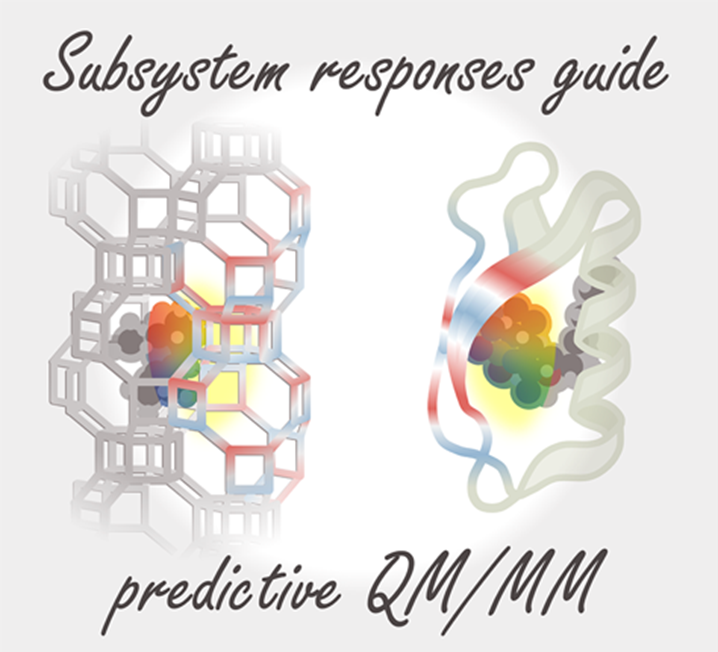
In material systems (left: examples of zeolites and organic structure-directing agents) and biomolecular systems (right: examples of enzymes and inhibitors), electronic states change locally due to intermolecular interactions. This study presents a new principle for automatically identifying "QM/MM boundaries",—which have long been a source of experience-dependent limitations in QM/MM calculations— using electronic state response as a guide.
●Research funding that served as the basis for this research achievement
MORI Hirotoshi
Funder: Research Center for Computational Science, National Institutes of Natural Sciences (NINS),
Okazaki Research Facilities
Grant Number: 24-IMS-C013
OZAWA Nichika
Funder: Research Center for Computational Science, National Institutes of Natural Sciences (NINS),
Okazaki Research Facilities
Grant Number: 25-IMS-C162
KUROKI Nahoko
Funder: Japan Society for the Promotion of Science
Grant Number: KAKENHI, Grant-in-Aid for Early-Career Scientists, 23K13711
【Paper Information】
Journal Name and Publisher: Advanced Science, Wiley -VCH
Paper Title: Ligand-Induced Electronic Response Enables Predictive QM/MM Simulations
Author: OZAWA Nichika, KUROKI Nahoko, MORI Hirotoshi
DOI: https://advanced.onlinelibrary.wiley.com/doi/10.1002/advs.202519137
【Glossary】
*1) QM/MM (Quantum mechanics/molecular mechanics) method
A molecular simulation method widely used for handling large and complex molecular systems, such as enzymatic reactions, drug-protein interactions, and chemical reactions in materials. It is a hybrid computational approach that combines quantum mechanics (QM) and molecular mechanics (MM). The method achieves both computational accuracy and efficiency by precisely calculating the important parts of a molecule directly involved in reactions and bonding, using QM, while approximating the remaining parts with classical MM.
*2) Semi-empirical methods
Electronic structure calculation methods that are based on quantum mechanics but simplify calculations by incorporating empirical parameters obtained from experimental data or high-accuracy calculations. While computational accuracy depends on the parameters used, the method excels in computational speed and is suitable for efficiently evaluating large molecular systems or many structures.
*3) Density Functional Theory (DFT)
A quantum chemical method that calculates the behavior of electrons, which determines the properties of molecules and materials, based on electron density. While rigorously tracking the motion of all electrons in a molecule is computationally difficult, DFT focuses on the distribution of electrons as a collective (electron density), thereby achieving practical chemical accuracy while keeping the computational burden manageable.
*4) Ab initio methods
Methods that calculate the electronic states of molecules based solely on the fundamental principles of quantum mechanics, without relying on experimental data or empirical parameters. Because it treats electron-electron interactions (electron correlation) rigorously, it can predict molecular properties with high accuracy; however, this comes at the cost of substantial computational demand.
【Expert Contact】
Name: MORI Hirotoshi
Organization: Faculty of Science and Engineering, Chuo University
Email: qc-forest.19d*chuo-u.ac.jp
Please replace * with @ when sending an email.

