
2025.12.22
News
New Microfluidics Technology Enables Highly Uniform DNA Condensate Formation: A Simple 'Micro-Vortex' Platform Driven by Mechanical Vibration
Microvortices generated by vibrating a microchip are applied to controlling the condensate-formation of DNA nanostructures
Abstract:
A research group led by Professor Hiroaki SUZUKI and Takeshi HAYAKAWA from the Faculty of Science and Engineering at Chuo University, graduate student Zhitai HUANG, graduate students Kanji KANEKO (at the time) and Ryotaro YONEYAMA (at the time), together with Specially Appointed Assistant Professor Tomoya MARUYAMA from the Research Center for Autonomous Systems Materialogy (ASMat), Institute of Integrated Research (IIR), Institute of Science Tokyo, and Professor Masahiro TAKINOUE from the Laboratory for Chemistry and Life Science, Institute of Integrated Research, Institute of Science Tokyo, has developed a novel and highly accessible technology for producing uniform Biomolecular Condensates*1) using a simple, low-cost vibration platform.
This method builds upon the unique vibration control technology originally pioneered by Professor HAYAKAWA. It eliminates the need for expensive equipment or complex microfluidic circuits. By utilizing simple mechanical vibration, it achieves precise control over condensate formation within a single aqueous phase similar to the cellular environment, establishing a highly versatile technology.
The research group's novel study employs the Vibration-Induced Local Vortex (VILV)*2) platform. This technology bypasses complex microfluidic pumping systems by employing stable micro-vortex arrays within a simple open device featuring a micropillar array. This is achieved using a standard piezoelectric vibrator. These vortices function as molecular traps, inducing uniform condensation by capturing and concentrating DNA molecules at their central regions. This approach enables condensation control within a single aqueous phase, preserving the activity of sensitive biomolecular components. The team successfully constructed highly uniform DNA condensates*3) and demonstrated precise regulation of their stability through a low-frequency “maintenance mode.”
Furthermore, the team successfully demonstrated the formation of complex patchy DNA condensate structures, highlighting the platform's capability to construct spatially organized biomaterials. Beyond this specific application, the versatility of the VILV platform is expected to contribute significantly to the fields of bottom-up synthetic biology and the fundamental study of cellular phase separation. We anticipate that this simple and accessible technology will be widely utilized as a standard tool for developing functional artificial cells and novel smart materials.
This research achievement was published in the online edition of the International academic Journal Materials Horizons by the Royal Society of Chemistry on November 21, 2025 (UK time).
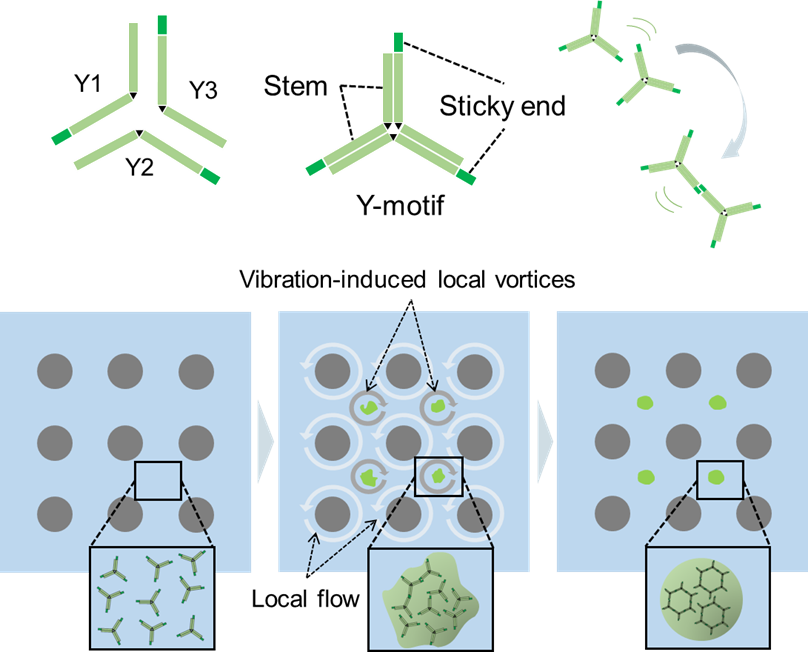
(Top) Schematic diagram of the basic unit (Y-motif) of DNA condensates and their binding via sticky-end interaction.
(Bottom) A schematic diagram illustrates how DNA condensate formation is regulated by VILV.
Condensate formation of Vibration-Induced Local Vortex (VILV) after application no1
Condensate formation of Vibration-Induced Local Vortex (VILV) after application no2
Condensate formation of Vibration-Induced Local Vortex (VILV) after application no3
●Research funding that served as the basis for this research achievement
Funder: Japan Society for the Promotion of Science
Grant Number:
・ KAKENHI JP24K01320, JP24H01155, JP23K22725, JP20H05935, JP24K08214
Research funding other than Grants-in-Aid for Scientific Research
・ Japan Keirin Autorace (IKA) promotion fund
・ The Institute of Science and Engineering of Chuo University
Journal Name and Publisher: Materials Horizons, Royal Society of Chemistry
Paper Title: A platform for the formation of uniform DNA condensate droplets using vibration-induced local vortices
Another: Zhitai HUANG, Kaneko KANJI, Ryotaro YONEYAMA, Tomoya MARUYAMA, Takeshi HAYAKAWA, Masahiro TAKINOUE, Hiroaki SUZUKI
DOI: https://doi.org/10.1039/D5MH01304F
*1) Biomolecular Condensates (or LLPS)
Also known as "membrane-less organelles." These are dense, liquid-like droplets of proteins and/or nucleic acids (like DNA) that form spontaneously inside living cells through Liquid-Liquid Phase Separation (LLPS). They are essential for organizing cellular processes. While recreating these structures in vitro often requires oil phases or crowding agents, this study's platform enables their precise formation in a "single aqueous phase," offering a highly biomimetic environment for fundamental analysis.
*2) VILV (Vibration-Induced Local Vortex)
A novel technology built upon the Vibration-Induced Flow (VIF) technique previously established by the research group. While standard VIF refers to general fluid motion caused by vibration, the innovation of VILV lies in the use of micropillar arrays to generate spatially localized, stable toroidal vortices. These vortices function as wall-less "virtual micro-chambers," capable of trapping and strongly concentrating molecules at their core without physical contact, enabling precise control within a single aqueous phase.
*3) DNA condensates
Chromosomes within cells are highly condensed with DNA, and DNA condensates are also being researched and applied in the field of DNA nanotechnology. Of particular interest are condensates of DNA nanostructures called DNA nanostars, which consist of several short single-stranded DNA molecules to form structures with multiple arms, such as Y-shaped or X-shaped configurations. By providing sticky ends of 4-10 bases at the tips of the arms, the binding between nanostars can be precisely controlled. This allows for the control of condensation and dissociation while incorporating functions such as molecular recognition.
- Expert Contact -
Name: SUZUKI Hiroaki
Organization: Faculty of Science and Engineering, Chuo University
Email: suzuki+
* Please replace "+"

