
2026.07.29
Marketing Research to Understand Consumer Behavior Across Physical and Online Channels

- Satoshi Nakano
- Associate Professor, Faculty of Commerce, Chuo University
Areas of Specialization: Marketing Research, Marketing Science, and Retailing
1. Consumer behavior across physical stores and online, and retail channel integration
In recent years, the shift to digital in retail has accelerated. Alongside, an increasing number of consumers are shopping online while using websites and apps. However, following the COVID-19 pandemic, we have also had a reason to reconsider the value of the physical experience. From product experiences that engage the five senses to interpersonal interactions and the convenience of immediate availability, physical stores offer unique advantages that cannot be replicated by online shopping. In practice, consumers generally do not rely exclusively on either physical stores or online channels; rather, they use both selectively. Their choice may vary with each shopping occasion or shift within the overall purchasing process. For example, a consumer might first gather product information in a physical store and then make the purchase online (a behavior called "showrooming").
Understanding consumer behavior that involves switching between retail channels highlights the need for modern retailers to adopt an approach known as omnichannel integration. This approach integrates various customer touchpoints across online and offline channels, as well as across different devices. One reason for this necessity is the increasing prevalence of consumer behaviors that carry the risk of free-riding such as showrooming. In this context, free-riding refers not only to switching channels between information search and purchase, but also to switching retailers entirely (for example, a consumer who searched for products in a retailer's physical store makes the purchase on another retailer's e-commerce site). Such behavior represents a significant loss for the original retailer. Consequently, many retailers are tasked with creating mechanisms that encourage consumers to use their channels, while delivering a seamless, high-quality customer experience throughout the entire customer journey before, during, and after purchase.
Nonetheless, understanding consumers is not straightforward in a complex structure where both information search and purchase involve multiple retailers and channels (see the Figure below)[1]. Consumers exhibit heterogeneity in their individual channel preferences. Moreover, this heterogeneity is not limited to differences between consumers; it can also occur within the same consumer over time, resulting in temporal heterogeneity that may change each time a selection is made. My research has focused on how to understand such heterogeneous consumer behavior and advance retail marketing in the digital era.
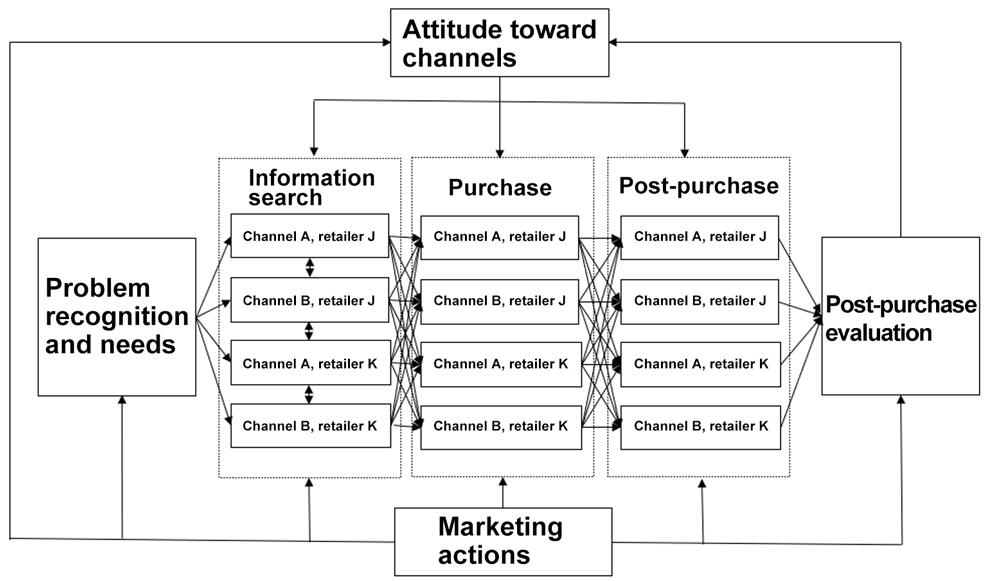
(Source) Blattberg et al. (2008, p. 637), Figure: Consumer channel choice throughout the purchasing process
2. The evolution of consumer data
In addition to changes in consumer and corporate behavior, the data available for research has also evolved in recent years. Traditional retail marketing research has largely relied on purchase records from physical stores, such as POS and ID-POS data. However, more recently, online purchase data has become accessible, allowing for analysis of consumer purchases across both physical and online channels. In addition, data related to information search, not just purchase timings, is now obtainable. Examples include behavioral logs such as search histories via smartphone or PCs and logs of app usage. These behavioral logs make it possible to capture detailed consumer behavior, including temporal information, based on actual actions.
On the other hand, when conducting consumer research, focusing solely on behavior provides only a limited understanding. A more effective approach is to examine both behavior and psychology. In my research, I have sought to achieve a multifaceted understanding of consumers by utilizing single-source data, which collects both behavioral and psychological data from the same individuals.
The quality of data is also a critical concern. For example, if many respondents provide careless answers in a survey, the overall quality of the data deteriorates. In today's fast-paced world, people are often busy and may participate in surveys using their smartphones during small pockets of free time. Establishing survey designs suited to this digital era and methods for evaluating response accuracy have become important not only in marketing research but also across disciplines such as political science, psychology, and sociology. More recently, concerns have been raised about data contamination caused by AI-generated responses that mimic human answers. Conversely, positive methodological approaches that effectively leverage AI to advance research are also emerging. I have also conducted research on marketing research methodologies that aim to obtain high-quality data and apply it meaningfully in both research and practice.
3. Research until now
My research combines two complementary themes: empirical research of consumer behavior in the retail sector and the development of marketing research methodologies to support such research. I will briefly introduce these themes.
In empirical research on retail, I have conducted studies such as Nakano and Kondo (2018)[2], which provides customer segmentation with purchase channels and media touchpoints using single source panel data, Nakano and Kondo (2018)[3], which proposed statistical modeling to capture temporal changes in channel choice behavior; and Nakano (2023)[4], which explored demand concentration in shopping basket composition across physical and online stores, highlighting new aspects not addressed by conventional theory. These findings are compiled in my book The Science of Customer Behavior in Retail Channel Integration (Nakano, 2025)[5]. I have also conducted research on contemporary retail marketing topics, including panic buying during the COVID-19 pandemic (Nakano et al., 2022)[6], platform competition strategies (Ichikohji et al., 2022)[7], personalization (Shibuse and Nakano, 2023)[8], and consumer choices in cashless payment (Nakano et al., 2024)[9]. These kinds of research are empirical research based on behavioral data on purchasing and media, psychological data, or combinations of both.
Regarding research on marketing research methodologies, I first examined biases that arise between mobile behavioral logs and survey responses in Nakano and Zanma (2017)[10]. More recently, I have investigated the use of trap questions to identify careless and insufficient effort respondents in surveys. One notable outcome of this work is Nakano, Takeuchi, and Nagasaki (2025)[11], which empirically demonstrated that trap questions not only identify careless and insufficient effort responses but also have spillover effects on responses to other survey items.
4. Future research themes
As the environment surrounding retail continues to evolve, related issues to be tackled is increasing. I have been motivated by a desire to conduct retail marketing research that contributes more directly to addressing social issues. For example, I seek to understand consumer behavior and retail responses in the context of disasters and extreme weather events. I am also eager to study issues related to overconsumption of goods and information, or addictive behaviors. The emergence of new channels, such as the metaverse, signals a shift in commercial practices, making strategies for channel integration between virtual and physical worlds an important research topic. Furthermore, with the growing prevalence of generative AI, it has become necessary to reconsider the methods used in marketing research to study consumer behavior. Future research challenges include developing methods to identify careless and insufficient effort responses in the AI era and examining both the positive and negative implications of leveraging AI in marketing research.
Research on Marketing continues to encounter new challenges alongside social changes. Over the past two decades, retailing has expanded beyond physical stores to include online and mobile channels. Similarly, marketing research has shifted from mail and home-visit surveys to online surveys. These changes were brought about by digitalization, and they have given rise to numerous new studies. Moreover, during this period, extraordinary events such as the Great East Japan Earthquake and the COVID-19 pandemic forced retailers to respond rapidly, while simultaneously accumulating valuable experience and knowledge. These developments can now be applied to emerging areas such as AI, the metaverse, and future responses to disasters and social issues. I believe that the appeal of our research field lies in the opportunity to tackle new phenomena while building upon past theories and methodologies.
Reference Literature
[1] Robert C. Blattberg, Byung-Do Kim, and Scott A. Neslin (2008). Database marketing: Analyzing and managing customers. Springer, New York.
[2] Satoshi Nakano and Fumiyo Kondo (2018). "Customer segmentation with purchase channels and media touchpoints using single source panel data," Journal of Retailing and Consumer Services, 41, pp. 142-152.
[3] Satoshi Nakano and Fumiyo Kondo (2018). "Online and Offline Channel Choice Modeling Based on a Mixed Hidden Markov Model," Operations Research as a Management Science Research, 63 (10), pp. 635-646. (in Japanese)
[4] Satoshi Nakano (2023). "Customer demand concentration in online grocery retailing: Differences between online and physical store shopping baskets," Electronic Commerce Research and Applications, 62:101336, pp. 1-9.
[5] Satoshi Nakano (2025). The Science of Customer Behavior in Retail Channel Integration. Chikura Shobo. (in Japanese)
[6] Satoshi Nakano, Naoki Akamatsu, and Makoto Mizuno (2022). "Consumer panic buying: Understanding the behavioral and psychological aspects," International Journal of Marketing and Distribution, 5 (2), pp. 17-35. [IJMD Outstanding Paper Award, Japan Society of Marketing and Distribution]
[7] Takeyasu Ichikohji, Sotaro Katsumata, Satoshi Nakano, Shinichi Yamaguchi, and Fumihiko Ikuine (2022). "Competitive Strategies of Communication Platforms in the Period of Hegemony, Maturity, and Growth," Organizational Science, 55 (3), pp. 34-48. (in Japanese)
[8] Masahiko Shibuse and Satoshi Nakano (2023). "How Should Retailers Utilize Personalized Advertising? The Role of Retailer Trust in Shaping Purchasing Behavior," Journal of Promotional Marketing, 16, pp. 26-45. [Society Award of the Japan Promotional Marketing Institute Inc.] (in Japanese)
[9] Satoshi Nakano, Sotaro Katsumata, Shinichi Yamaguchi, Takeyasu Ichikohji, and Fumihiko Ikuine (2024). "How do consumers pay? Choice behavior modeling using situational and individual factors," Journal of Marketing Science, 31 (1), pp. 9-37. (in Japanese)
[10] Satoshi Nakano and Daichi Zanma (2017). "The Difference between Self-reported Survey and Behavior Log in Media Usage Duration: An Empirical Study in Individual Smartphone Usage Duration," The Japanese Journal of Behaviormetrics, 44 (2), pp. 129-140. (in Japanese)
[11] Satoshi Nakano, Makito Takeuchi, and Takahiro Nagasaki (2025). "Do trap questions influence subsequent survey responses?:The secondary effects on attention from methods detecting careless and insufficient effort responding ," Advances in Consumer Studies (in press). [Special Issue Paper Award (Oral Presentation), Japan Association for Consumer Studies] (in Japanese)
Satoshi Nakano/Associate Professor, Faculty of Commerce, Chuo University
Areas of Specialization: Marketing Research, Marketing Science, and Retailing
Satoshi Nakano was born in Ota City, Gunma Prefecture in 1987. He completed the Doctoral Program in the Graduate School of Systems and Information Engineering, the University of Tsukuba. He holds a Ph.D. in Policy and Planning Sciences. Before assuming his current position, he served as a Chief Data Scientist in the Advanced Technology Division at INTAGE Inc. and as a Full-Time Senior Lecturer in the Faculty of Economics, Meiji Gakuin University.
He has received awards including the IJMD Outstanding Paper Award of the Japan Society of Marketing and Distribution, Special Issue Paper Award of the Japan Association for Consumer Studies, the Research Encouragement Award and the Special Jury Prize from the Japan Institute of Marketing Science, and the IEEE/ACIS SNPD 2022 Best Paper Award.
His research has been published at Journal of Retailing and Consumer Services, Electronic Commerce Research and Applications, Computers in Human Behavior Reports, Studies in Computational Intelligence, and Japanese refereed journals.

