
2026.06.24
Reconsidering the Issue of Unpaid Child Support: What Will Be the Impact of Revisions to the Civil Code and the Civil Execution Act? ―Eleventh Collaborative Course with "Otemachi Academia"

- Kenichiro Endo, Tokiyo Shimizu, Kimimasa Hata
- Kenichiro Endo/Professor and Dean of Faculty of Law, Chuo University
Tokiyo Shimizu/Professor, Faculty of Law, Chuo University
Kimimasa Hata/Professor, Faculty of Law, Chuo University
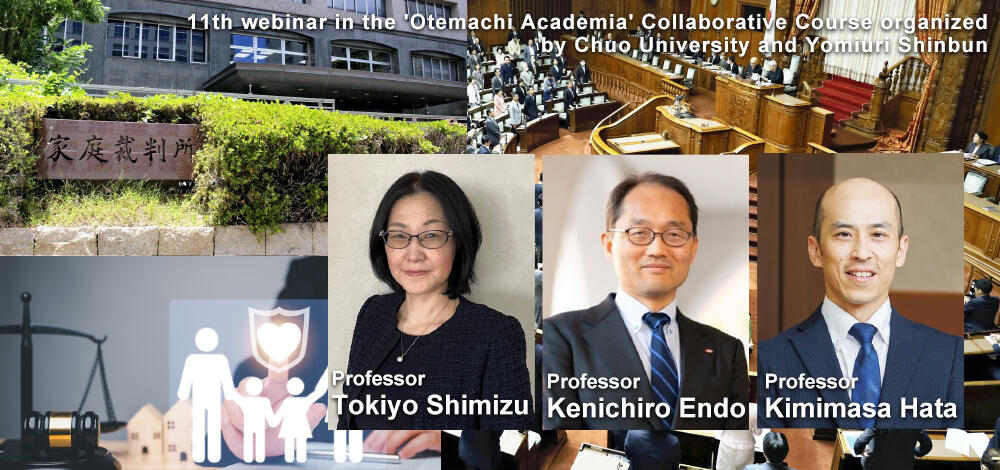
Chuo University and Otemachi Academia is a joint program for widely sharing the valuable knowledge cultivated by Chuo University throughout its long history. The 11th session was held on September 17 under the theme: "Reconsidering the Issue of Unpaid Child Support: What Will Be the Impact of Revisions to the Civil Code and the Civil Execution Act?". Focusing on the growing social issue of unpaid child support and the 2024 revision to the Civil Code (Act Partially Amending the Civil Code (Act No. 33 of 2024), promulgated on May 24, 2024; scheduled to take effect within two years of promulgation, except for certain provisions), the session featured lectures by three faculty members: Professor Tokiyo Shimizu, an expert in family law; Professor Kenichiro Endo, a specialist in secured transactions law; and Professor Kimimasa Hata, a high-level researcher of the Civil Execution Act. Following the lectures, Professor Endo moderated a talk session among the speakers.
What is child support?
Shimizu:
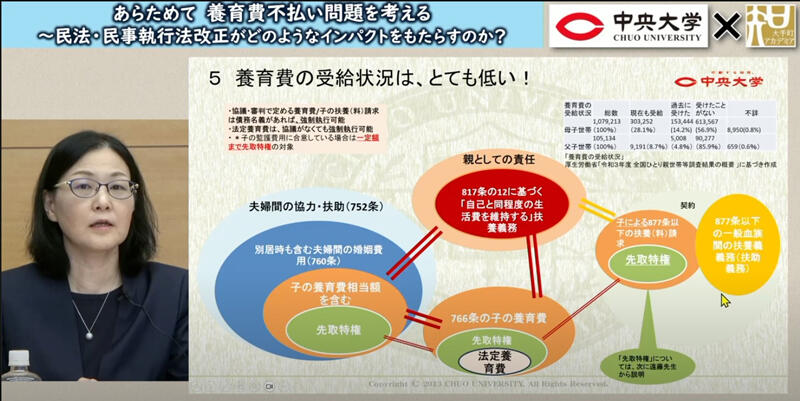
The Civil Code's system of parental authority defines the responsibility of parents to provide custody, care and upbringing for their minor children. The 2024 revision to the Civil Code clearly stipulates that parents are legally responsible for the custody, care and upbringing of their children, regardless of whether parents hold parental authority or are married. This is set forth in Article 817-12. The Code also stipulates that parents must provide a level of support that allows their children to maintain a standard of living equivalent to their own.
In addition to being a parental responsibility, child support can also be understood as a claim for support centered on the child. Before Article 817-12 was established, discussions on child support were generally based on Article 877, which concerns support obligations. Specifically, Article 877 stipulates that lineal relatives and parents/siblings have a mutual obligation to provide support for one another.
Article 752 of the Civil Code stipulates the obligations of married couples to live together, cooperate with, and support each other. A married couple is obligated to share household and childcare responsibilities in maintaining their standard of living, as well as to provide mutual financial support. Furthermore, Article 760 states that the expenses necessary to maintain a married life (marital expenses) are to be shared between the spouses. The issue of child support is also considered to fall within these marital expenses. When a couple separates, it is common for the spouse living with the child to claim marital expenses, including the child's support, from the other spouse. In the case of divorce, Article 766 of the Civil Code provides that the expenses related to the custody and care of the child shall be determined through mutual consultation. These expenses related to the custody and care of the child generally correspond to what is commonly referred to as child support. The term "child support" itself does not appear in the Civil Code.
The 2024 revision to the Civil Code will introduce a system of statutory child support. This system allows a minimum amount of child support to be claimed even if no agreement has been reached at the time of divorce. The statutory child support is intended only as a temporary measure serving as a "bridge" until the couple reaches their own agreement. The Ministry of Justice has proposed a monthly amount of 20,000 yen, which will be finalized after gathering public opinions.
Liens granted to child support beneficiaries
Endo:
Under the Civil Code's principle of equality among creditors, all creditors are treated equally, and any remaining assets are distributed in proportion to the amounts of their claims. For example, assume that debtor Y goes bankrupt and has remaining assets of 3 million yen. Also suppose that creditors A, B, and C hold claims of 1 million, 2 million, and 3 million yen, respectively. In this case, their respective shares would be 500,000 yen, 1 million yen, and 1.5 million yen, in proportion to their claims.
However, if a security interest exists, this principle can be overridden to allow preferential repayment of the secured creditor. For example, in the hypothetical case introduced above, if only creditor A were to hold a security interest against debtor Y, creditor A could recover their 1 million yen claim in full ahead of the other creditors. The remaining 2 million yen would then be divided proportionally between creditors B and C.
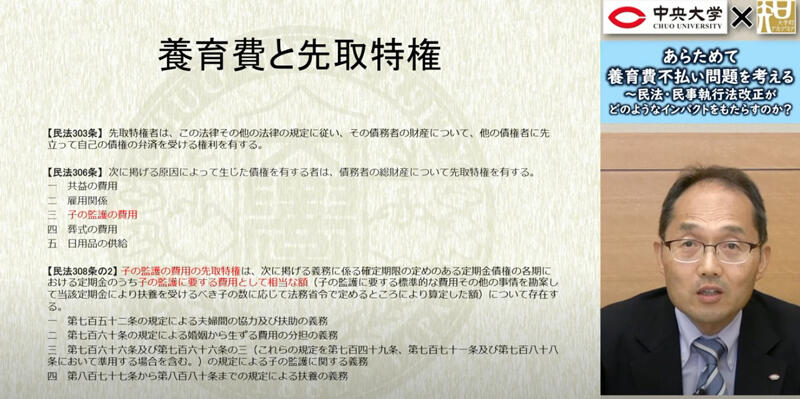
Among security interests, there is a system for lien that grants certain creditors the right to collect repayment ahead of others. Under the revised Civil Code, child support beneficiaries will be granted liens as stipulated in Articles 306(ⅲ) and 308-2. This ensures that even if the obligor experiences financial difficulties, the beneficiary can preferentially receive payment ahead of other creditors. However, whether this will actually result in successful collection remains uncertain. Crucial factors will include accessibility to the judicial system and ease of exercising the rights.
Enforcement of child support payments
Hata:
The right holder is not permitted to engage in self-help, meaning the use of force to compel payment from the debtor. The state provides a system through which the courts can enforce the rights of the claimant. There are two main methods of enforcing rights: compulsory execution and the exercise of secured interests. Compulsory execution requires a legal title, such as a court judgment or ruling, which can be difficult to acquire. Conversely, the exercise of secured interests can be carried out by any party who holds such a right.
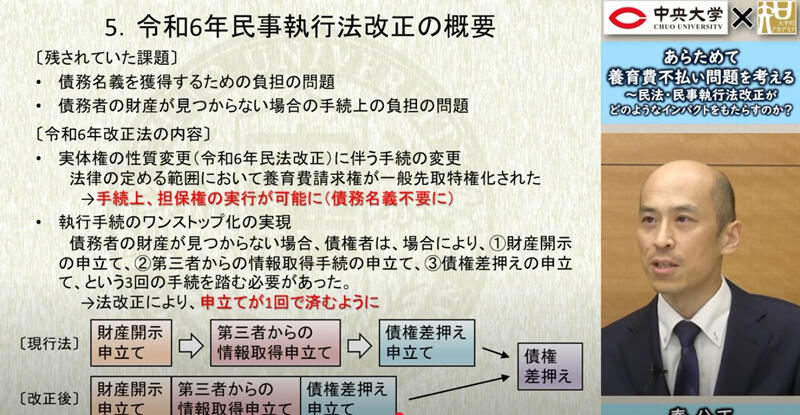
If an obligor fails to pay child support and is a salaried employee, the most effective target is the salary claim held by the employer when filing for garnishment at a court. Under current law, the right to claim child support is not considered a secured interest, so the claimant must hold a legal title. The court does not investigate the obligor's workplace; instead, the claimant must identify it themselves. Furthermore, the claimant is responsible for pursuing collection directly with the employer. Thus, the claimant bears a considerable procedural burden.
Since 2000, there have been four major revisions to the Civil Execution Act concerning the right to claim child support. The first revision relaxed the requirements for initiating proceedings. Specifically, it allowed the process to begin if there has been failure to pay in the past. Previously, it was necessary to assume that payment had not been made by the due date. The second revision expanded the garnishable portion of the obligor's salary from one-quarter to one-half. The third revision permitted the use of indirect enforcement; that is, in cases where child support had not been paid, it allowed the claimant to notify the obligor in advance of an amount exceeding the agreed payment in order to encourage compliance. The fourth revision enabled the claimant to obtain information about the obligor's employer, real estate, and bank accounts from third parties such as municipal authorities.
The 2024 revision to the Civil Code, which grants child support claims the status of a general lien, has a significant impact on enforcement procedures. The Ministry of Justice has proposed a limit of 80,000 yen per month for the scope of the lien. It will make a final decision on the limit after soliciting public comments.
Anticipated benefits and remaining challenges following revision to the Civil Code
Endo:
I would like to proceed with our discussion by referring to the questions which I collected in advance. Firstly, who is the party entitled to claim child support?
Shimizu:
Typically, the parent B who lives with child C claims child support from the other parent A, who does not live with the child. Although this can be seen as a right of parent B against parent A, when considering the obligation of both parents to share the expenses of raising child C, it can also be understood that parent B is exercising child C's right and making the claim in parent B's name, with child C ultimately benefiting. In the context of the 2024 revision to the Civil Code, there were discussions about clarifying child C's rights and exploring whether the claim could be structured as parent B acting as child C's representative in claiming the right against parent A; however, this approach was ultimately not adopted.
Endo:
What is your view on the Ministry of Justice's proposal of setting statutory child support at 20,000 yen per month?
Shimizu:
I believe it is meaningful if, in cases where an agreement on child support cannot be reached, the statutory amount can be collected as a minimum by combining it with the lien. There are differing opinions on whether the proposal of 20,000 yen per month is appropriate; however, even if a higher amount were set, it might not be paid if the obligor cannot afford it. In such cases, the court may ultimately rule that payment is not required.
Endo:
What challenges remain following the recent revision to the Civil Code?
Hata:
One remaining challenge is that the statutory child support amount of 20,000 yen is low, so the parties still need to reach their own agreement on child support. Similarly, the priority of the lien cannot be asserted without an agreement between the parties. It appears that the revision has yet addressed the issue of settling fundamental arrangements.
Shimizu:
Some municipalities provide support for reaching agreements on child support. Recently, private child support guarantee companies have also attracted attention. The opposition parties have proposed legislation regarding the advance payment of unpaid child support. It goes without saying that child support is crucial for the well-being of children. While various social security systems exist, we must establish a framework that ensures benefits are provided where and when they are needed.
*Please see below for the video of the 11th session of Chuo University and Otemachi Academia "Reconsidering the Issue of Unpaid Child Support: What Will Be the Impact of Revisions to the Civil Code and the Civil Execution Act?", held on September 17, 2025.
Reconsidering the Issue of Unpaid Child Support: What Will Be the Impact of Revisions to the Civil Code and the Civil Execution Act?
Kenichiro Endo/Professor and Dean of Faculty of Law, Chuo University
Kenichiro Endo is a Professor and Dean of the Faculty of Law, Chuo University. He holds a master’s degree in law. After serving as a Lecturer and Assistant Professor in the Faculty of Humanities and Social Sciences, Iwate University, as an Assistant Professor in the Faculty of Law, Dokkyo University, and as an Associate Professor in the Faculty of Law, Chuo University, he held his current position in 2009.
Tokiyo Shimizu/Professor, Faculty of Law, Chuo University
Tokiyo Shimizu is a Professor of the Faculty of Law, Chuo University. She holds a master’s degree in law. She completed the Master’s Program in the Graduate School of Law and Politics, Osaka University. After serving as a Lecturer and Associate Professor in the Faculty of Law and Policy, Tezukayama University, as an Associate Professor and Professor in the Konan University Law School, and as a Professor at the Center for Education in General Studies, Konan University, she held her current position in 2023.
Kimimasa Hata/Professor, Faculty of Law, Chuo University
Kimimasa Hata is a Professor of the Faculty of Law, Chuo University. He holds a master’s degree in law. He completed the Master’s Program in the Graduate School of Law, Waseda University. He held his current position in 2014, and majors in the civil procedural law.

