
2026.06.10
Persevering Even When Bridges Sink in Heavy Rainfall -- Overcoming three types of challenges to achieve resilient recovery

- Hidetoshi Nishioka
- Professor, Faculty of Science and Engineering, Chuo University
Areas of Specialization: Civil Engineering, Geotechnical Engineering, and Earthquake Engineering
1. Infrastructure strategy in an era of intensifying disasters and rapid repair
Japan is blessed with abundant natural environments. At the same time, it is a country with a high risk of natural disasters such as earthquakes, volcanic activity, typhoons, and heavy rainfall. In recent years, due in part to the effects of global warming, the occurrence and intensity of localized heavy rainfall have increased. As a result, such heavy rainfall causes river flooding and landslides, inflicting severe damage on vital infrastructure such as roads and railways.
Until recently, infrastructure design and construction had been guided by the principle of ensuring that structures would not exceed their design limits under a disaster level assumed from past experiences. However, the heavy rainfall events of recent years have exceeded the assumptions made at the time of construction, resulting in severe damage across various regions. Given this situation, it is unrealistic to rebuild all existing bridges so that they would never fail even in unprecedented disasters. Going forward, it is important not only to advance the renewal of key structures whose failure would have extensive economic impacts, but also to take proactive measures to ensure rapid repair and restoration of the structures that form the foundation of everyday life in local communities in the event of a major disaster.
For example, river-crossing bridges play a crucial role in supporting daily commuting, logistics, and evacuation routes during emergencies. However, heavy rainfall can result in scour (erosion) around bridge piers, ultimately leading to damage such as sinking or even washout. Implementing preemptive measures (such as replacement or major reinforcement) for all bridges exposed to such risks would require enormous costs and time. In the future, it will be necessary to accept a certain level of risk for minor damage. Rather than incurring high costs for preemptive measures, we should prepare to carry out emergency repairs and reinforcements promptly in the event of actual damage, so that the bridge can be reopened as quickly as possible without hindering early restoration and recovery efforts.
This concept is referred to as "resilience," meaning "flexibility" and "capacity for recovery." This represents a perspective in which infrastructure is not designed with a focus on being unbreakable; rather, it possesses the ability to recover quickly when damage occurs. At the national level, Japan has promoted the National Resilience Policy, which advances the development of a disaster-resilient and flexible system across the country[1]. It is essential for Japanese society as a whole to shift its mindset and share a resilient approach.
2. Damage to bridges caused by heavy rainfall and the reality of restoration
The types of damage to bridges caused by heavy rainfall can be broadly divided into two categories. The first is large-scale damage such as collapses or washouts (Photograph 1). The second is moderate damage in which bridge piers (the columns standing in the river) sink or tilt due to scour (Photograph 2). Large-scale damage tends to attract significant media attention due to its impact. However, moderate damage actually occurs more frequently and cannot be ignored from the perspective of total damage throughout Japan.
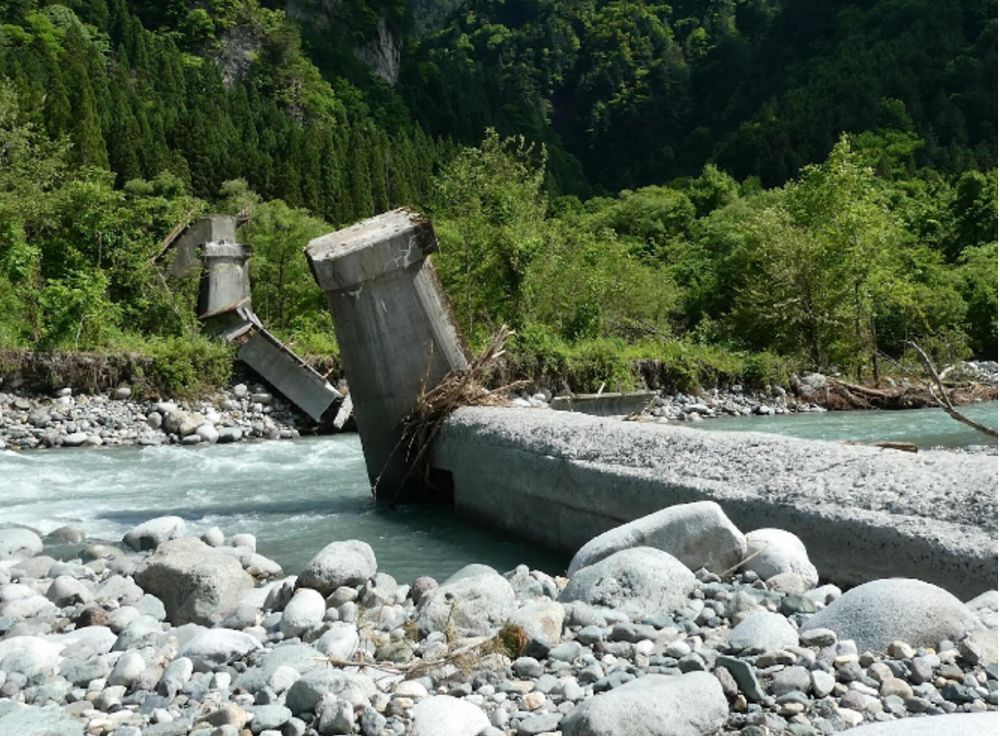
Photograph 1: Example of large-scale damage due to washout (photograph by author)
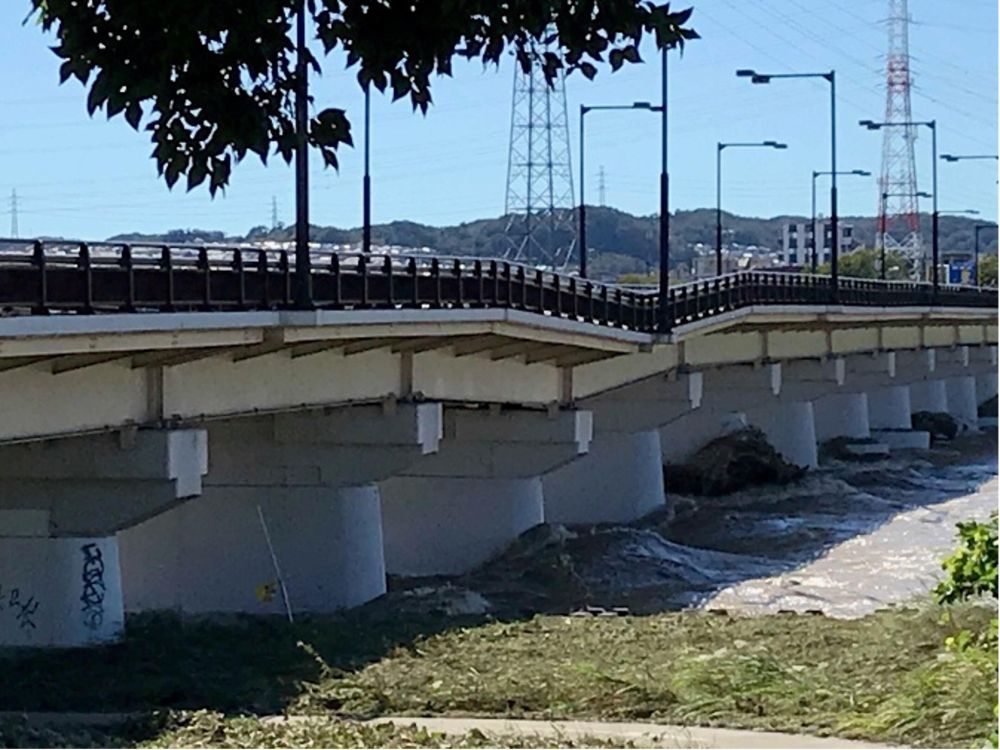
Photograph 2: Example of moderate damage caused by scour (photograph by author)
In cases of moderate damage, the bridge structure itself often remains. Nevertheless, traffic can be suspended for long periods of time, severing regional transportation and significantly hindering recovery. While repair or reinforcement could potentially allow the bridge to be reused, it has historically been difficult to sufficiently strengthen damaged bridges to withstand future heavy rainfall or earthquakes. As a result, replacement has been chosen as the course of action. Consequently, long-term closures are the reality until construction of the replacement bridge is completed. When considering such situations, preparing for moderate damage should be a high priority. The concept of resilience is needed in such cases. Immediately after a disaster, emergency restoration should be carried out to ensure necessary minimal traffic flow, followed by full-scale replacement in the second phase. For railway bridges, this approach is already being implemented by prioritizing early restoration across the entire network. In order to protect local communities, it is essential to further expand the application of such a resilient approach.
3. Three challenges that must be overcome for quick bridge repair
When a bridge is damaged by heavy rainfall, the primary desire of people is for the bridge to be made passable as quickly as possible. In reality, however, repairing a bridge promptly and restoring its usability is not easy. Behind this difficulty lie three challenges that must be overcome.
The first challenge is the lack of research. When a bridge pier sinks or tilts, researchers do not yet fully understand the level of emergency reinforcement required to make the bridge safe again, or the extent at which the bridge remains dangerous. Until now, damaged bridges have often been deemed unsafe and replaced. Thus, the lack of scientific evidence constitutes the first major challenge.
The second challenge is on-site difficulties. Even if research were to indicate that emergency reinforcement could potentially make a bridge safe to use, it is difficult to make an immediate judgment on whether traffic can actually cross the bridge because the time and information available are limited immediately after a disaster. The extent of damage varies for each bridge, and factors such as river flow and ground conditions also affect how the bridge is impacted. In other words, the second major challenge is the lack of a system to enable prompt on-site decision-making.
The third challenge is the approach by society. Taking time to confirm safety may lead to criticism that restoration is proceeding too slowly. On the other hand, reopening the bridge quickly can leave lingering concerns about potential danger. Moreover, emergency restoration requires special construction work and additional funding. Securing such resources is often difficult, particularly for local railways and community road bridges, leading to prolonged restoration or even forced closure. To overcome this challenge, it is essential for society as a whole to adopt the mindset of valuing "infrastructure that can be quickly repaired even when damaged," rather than "infrastructure that never breaks." Society must also establish appropriate funding mechanisms and institutional support.
Before joining Chuo University, I worked as an engineer and researcher in the railway sector. I was involved in emergency restoration and early restoration of bridges damaged by heavy rainfall and earthquakes. At disaster sites, I faced both questions of "Why can't we use the bridge if it is still standing?" and concerns of "Is it really safe?" In other words, I experienced firsthand that early restoration is only possible by aligning the three elements of research, on-site operations, and society. This experience became the starting point for my awareness of the three challenges and has led to my current research. It is important to note that overcoming the challenge of approach by society depends on surmounting the first challenge of the lack of research and the second challenge of on-site difficulties. If the ability to safely repair bridges is scientifically demonstrated and a system is established for fast decision-making on-site, we will be able to properly fulfill our accountability by explaining why the bridge can be reopened so quickly.
The efforts of my laboratory are aimed precisely at addressing these challenges. Through model experiments and numerical analyses, we reproduce cases in which damage either propagates or does not propagate during emergency restoration, thereby clarifying judgment criteria[2] and working to overcome the first challenge. In addition, to resolve the second challenge, we have proposed a mathematical approach that predicts future behavior based on the limited information available on-site while accounting for uncertainties[3]. Going forward, I aim to contribute to overcoming the third challenge through practical implementation of these methods.
4. Learning space connected to society -- Toward a disaster-resilient future
In actuality, the three challenges impeding the early restoration of bridges are not unique to bridges. Rather, they are challenges common to all infrastructure, including roads, levees, and water and sewage systems. No matter how advanced the technology, without scientific validation it cannot be used; without the ability to make judgments on-site, technology cannot be implemented; and without societal understanding and institutional support, infrastructure cannot be sustained. Initiatives that consciously address all three of these challenges are key to building infrastructure that is resilient to disasters and capable of flexible, rapid recovery.
The Faculty of Science and Engineering at Chuo University will be progressively reorganized in April 2026, transitioning to a three-school system comprised of the Faculty of Fundamental Science and Engineering, the Faculty of Science, Engineering and Society, and the Faculty of Advanced Science and Engineering. The Department of Civil and Environmental Engineering, to which I belong, will become part of the Faculty of Science, Engineering and Society. Together with the Department of Data Science for Business Innovation and the Department of Integrated Science and Engineering for Sustainable Societies, our department will cultivate human resources capable of addressing diverse and complex social challenges based on a foundation in science and engineering. The Department of Civil and Environmental Engineering also provides education that equips students with fundamental skills to respond to new technologies, design capabilities for creating living spaces in harmony with environmental, social, and economic considerations, and technological expertise to build a safe and secure society. In line with the faculty reorganization, a new curriculum will be introduced in the 2026 academic year. The new curriculum aims to foster human resources who can directly contribute to building disaster-resilient societies.
To realize the human resource development goals of the Faculty of Science, Engineering and Society and the Department of Civil and Environmental Engineering, I engage in research that consciously addresses the three challenges introduced above with students. Through experiments and analyses, students gain hands-on experience encompassing the three perspectives of research, field practice, and society. I believe that this learning method will serve as a valuable foundation for students as they advance into their future careers. Confronting the real-world challenge of disasters and delivering the outcomes to society provides an educational environment that cultivates the next generation of engineers.
This learning environment also presents a significant opportunity for high school students considering their future studies. Students can directly experience how learning at university connects to real societal challenges and witness how their own research can contribute to the safety and well-being of people's lives. As we work to achieve a society that is resilient to disasters and capable of flexible recovery, I sincerely hope that many of you develop an interest and choose to study in our department.
(Note) Part of this research was supported by JSPS Grant-in-Aid for Scientific Research (C) JP20K04687.
[1] National Resilience website, Cabinet Secretariat
[2] Hirano, M., Nishioka, H., and Yamakuri, Y. "Proposal for a Method to Predict the Local Scour Damage of River Bridges and to Evaluate the Residual Bearing Capacity after Scour," Japanese Journal of JSCE, Vol. 80, No. 11, 2024.
[3] Sasaki, Y., Nishioka, H., Kasahara, K., Sanagawa, T., and Otake, Y. "Reliability Assessment for Bearing Capacity of Shallow Foundation after Scouring under Live Load by Bayesian Inference," Japanese Journal of JSCE, Vol. 79, No. 15, 2023.
Hidetoshi Nishioka/Professor, Faculty of Science and Engineering, Chuo University Areas of Specialization: Civil Engineering, Geotechnical Engineering, and Earthquake Engineering
Hidetoshi Nishioka graduated from the Faculty of Engineering, School of Engineering, Tohoku University. He completed the Master’s Program in the Division of Engineering of the Graduate School of Engineering, Tohoku University. He received a Ph.D. in Engineering from Tokyo Institute of Technology. He joined the Railway Technical Research Institute in 2001, where he held positions such as Senior Researcher and Laboratory Director. He was appointed to his current position in 2019.
His areas of expertise are civil engineering, geotechnical engineering, and earthquake engineering. His research focuses primarily on foundation structures that support buildings and bridges, as well as underground structures such as tunnels, with an emphasis on R&D and construction method development that take into account practical applications from design and construction to maintenance and management.
He received the JSCE Paper Award (2009), JSCE Technology Development Award (2007, 2019), Japanese Geotechnical Society Paper Award (2022), and Japanese Geotechnical Society Technology Development Award (2018, 2025).

