
2026.02.25
Western History and Contemporary Society as Reflected in Opera -Sin and forgiveness, reconciliation and salvation

- Taiichiro Sugizaki
- Professor, Faculty of Letters, Chuo University
Areas of Specialization: Western Medieval History, Church History, and Veneration of Relics
In recent years, the field of historical research has expanded beyond politics and economics to encompass people's ways of thinking and customs. In the first half of the 20th century, a French historical research group known as "École des Annales" sparked a significant shift by studying the history of social norms and values that were unconsciously shared in everyday life. This approach eventually gave rise to studies that examined the history of Western society and culture through both Christian teachings (for example, sin and punishment, miracles and salvation, the afterlife, and morality) and the lingering values, emotions, and customs inherited from pre-Christian times. Today, the range of historical sources being examined has greatly diversified. An increasing number of researchers are exploring the expressions of joy, sorrow, and longing portrayed in literature, art, and music from antiquity to the present. This approach fosters interdisciplinary scholarship that transcends traditional academic boundaries. These trends have also spread to Japan through translation.[1] Perhaps as a result of these trends, I have pursued research on Western history through the lens of the Church and cultural expression.[2] In this article, I explore the spiritual history and social messages embedded within operatic narratives and theatrical stagings that deal with themes such as sin, forgiveness, reconciliation, and salvation.
1. Wagner and Weber
Around the 13th century, the Catholic Church instituted the Sacrament of Penance (commonly known as confession) that requires all believers to confront their sins and seek forgiveness at church. Confession is still practiced today. This practice of repentance and forgiveness is deeply ingrained in the consciousness of Western peoples. It has become a recurring theme in literature and the arts, including opera. One such example is Richard Wagner's Tannhäuser. The titular poet-knight Tannhäuser is condemned by his peers after his debauched past is revealed. His lord commands him to receive absolution by journeying to Rome and confessing his sins to the Pope. This reflects actual medieval Church regulations, in which people who had committed serious sins were often ordered to undergo penance in the form of pilgrimages to sacred sites. Another relevant example is Carl Maria von Weber's Der Freischütz (The Marksman). The protagonist Max is a gifted sharpshooter who enters into a pact with the Devil. When Max's transgression is exposed, the local community turns against him. Just as the lord is about to pronounce punishment, a hermit suddenly appears and grants Max a year of atonement in recognition of his repentance, offering him the chance to be forgiven. The lord accepts this arrangement. The opera concludes with Max, who has completed his period of atonement, being approved to marry his beloved. The hermit (or anchorite) appearing at the climax of the story is an appropriate figure to deliver resolution to the conflict. Hermits were monks or nuns who withdrew from society to engage in asceticism through fasting and prayer in forests or remote areas. Hermits earned deep trust from both clerics and laypeople. As the number of hermits rose sharply during the 11th and 12th centuries, the Church began encouraging them either to seek official recognition or to affiliate with established monasteries. One particularly well-known hermit was Saint Francesco of Assisi (Assisi is a town located in the central part of Italy), who lived in seclusion and practiced severe asceticism on the outskirts of town. Saint Francesco of Assisi was frequently depicted in paintings and films. In the early 13th century, he received papal approval to found a new monastic order, and his influence would go on to spread broadly across the Western world.[3]
2. Mozart and Da Ponte
Mozart collaborated with his librettist Lorenzo Da Ponte to compose several operas that explore the themes of sin, forgiveness, and punishment. One notable example is Don Giovanni. After a life of unrestrained womanizing, Don Giovanni is confronted by the ghost (in the form of a graveyard statue) of the commander, who was a nobleman killed by Don Giovanni. At this point, the opera builds to its climactic conclusion in the dramatic key of d-moll. Instead of seeking vengeance or immediately dragging Don Giovanni to hell, the ghostly figure first urges him to repent, offering a final chance at forgiveness. When Don Giovanni refuses, he is seized and dragged into hell while screaming madly. The story draws upon the long-standing Don Juan legend and echoes elements of didactic literature in which ghosts (graveyard statues) punish wrongdoers. Don Giovanni can therefore be seen as a fusion of folk tradition and Church doctrine.[4] Da Ponte labeled the work a "dramma giocoso", which can be translated as a "humorous drama," and such works often include comedy and tragedy. This suggests that the opera is not a simple moral tale, but rather a nuanced portrayal of the human condition of being torn between good and evil, doctrine and transgression, and forgiveness and punishment.
Another example is Le Nozze di Figaro (The Marriage of Figaro). In this opera, the protagonist Figaro is a servant to a Count who attempts to seduce Figaro's fiancée, Susanna. However, the Count's actions turn the entire household, including the Countess herself, against him. Ultimately, the Count is forced to beg his wife for forgiveness. In the final scene, the Countess gently whispers words of pardon, and the curtain falls on a moment of reconciliation. Notably, this opera features no pope, no hermit, nor any messengers from the afterlife. Through their joint works, Da Ponte and Mozart may have sought to emphasize that words of apology and forgiveness can bind people together and lead to reconciliation and redemption. However, we must remember that the opera premiered just before the outbreak of the French Revolution, which was a period of great historical transition. With that in mind, it is also possible that the creators, mindful of the royal court, chose to present a resolution stripped of overt political content.
3. Message from director Valentin Schwarz
Although I could discuss many more works, I would like to conclude with a personal anecdote. In 2024, I had the opportunity to attend the Bayreuther Festspiele and see Wagner's four-part piece Der Ring des Niebelungen. Based on Norse mythology and Germanic legend, the opera presents a drama of love, conflict, and ultimately, redemption. This narrative structure is an enduring archetype of opera. Since 2022, production of Der Ring des Nibelungen had been directed by Valentin Schwarz, who reinterpreted the work to focus on themes such as the collapse of patriarchy and the rejection of violence and power. Initially, Schwarz's rendition was met with harsh criticism. However, after numerous revisions, the production seemed to be gaining broader understanding and acceptance among audiences by its third year. In Schwarz's production, the supreme male deity Wotan is portrayed as a mafia boss consumed by a lust for power and wealth. His ambitions are ultimately shattered by his closest family members and confidants; specifically, Fricka, Brünnhilde, and Siegfried. This leads to the collapse of a patriarchal, family-centered social order and the arrival of a world rooted in reconciliation. One striking and somewhat disconcerting moment came at the end of the four-night opera, when an animated image of twin fetuses embracing in the womb was projected onto the stage. While initially discomforting, this imagery can be interpreted as a symbol of reconciliation after prolonged conflict. It may also be read as a commentary on the present world, in which global conflicts persist and powerful leaders often capture public attention by engaging in a peculiar form of masculinity which uses inflammatory rhetoric to sow division. Perhaps, Schwarz intended his production as a message to our contemporary society.[5]
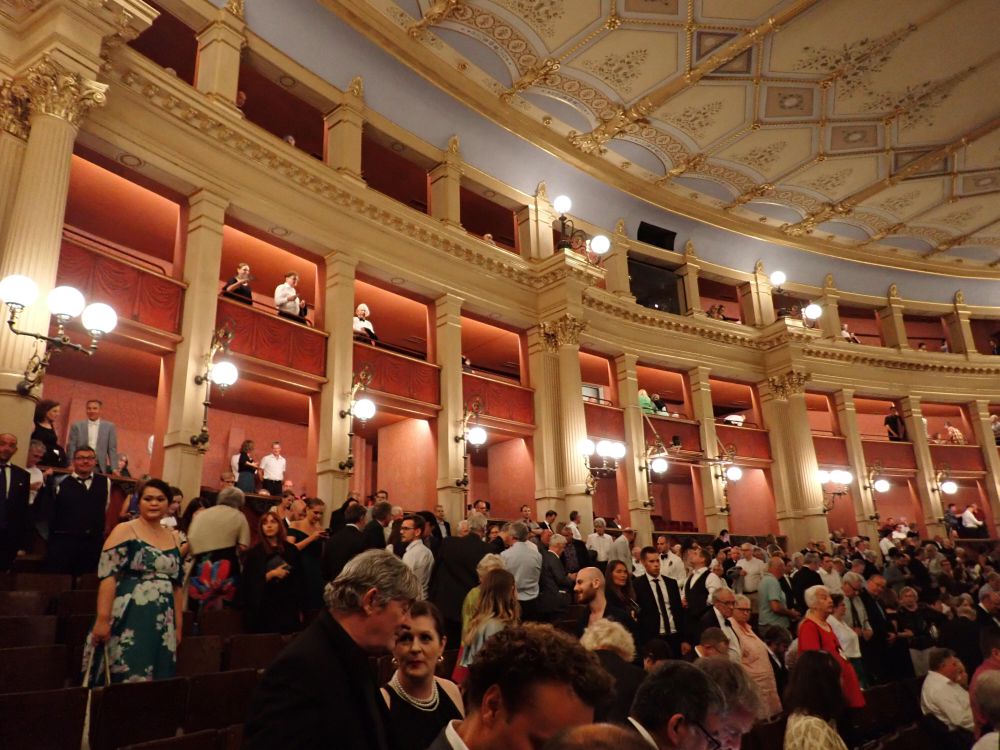
Theatergoers await the start of a performance inside the Bayreuther Festspielhaus (photo by author)
In 2024, the Australian conductor Simone Young became the first woman ever to lead a performance of Der Ring des Niebelungen at Bayreuther Festspielhaus. This achievement drew considerable attention. When Young stepped out for the curtain call after the performance, she was greeted by thunderous applause from the audience, which had filled the venerable Festspielhaus to capacity. There were shouts of bravo--or rather brava--and rhythmic foot-stomping on the wooden floors, which is the highest form of praise in the opera house. In that moment, the hall transcended differences of origin, gender, social status, and conflict, and became filled with a sense of hope for a new generation; that is, a future created through forgiveness and reconciliation, with happiness for all.
Wagner lived through the tumultuous mid-19th century, and he was an active participant in civic revolution in addition to being an artist. Similarly, opera itself can be seen as both a product molded by history and a message directed toward contemporary and future societies.
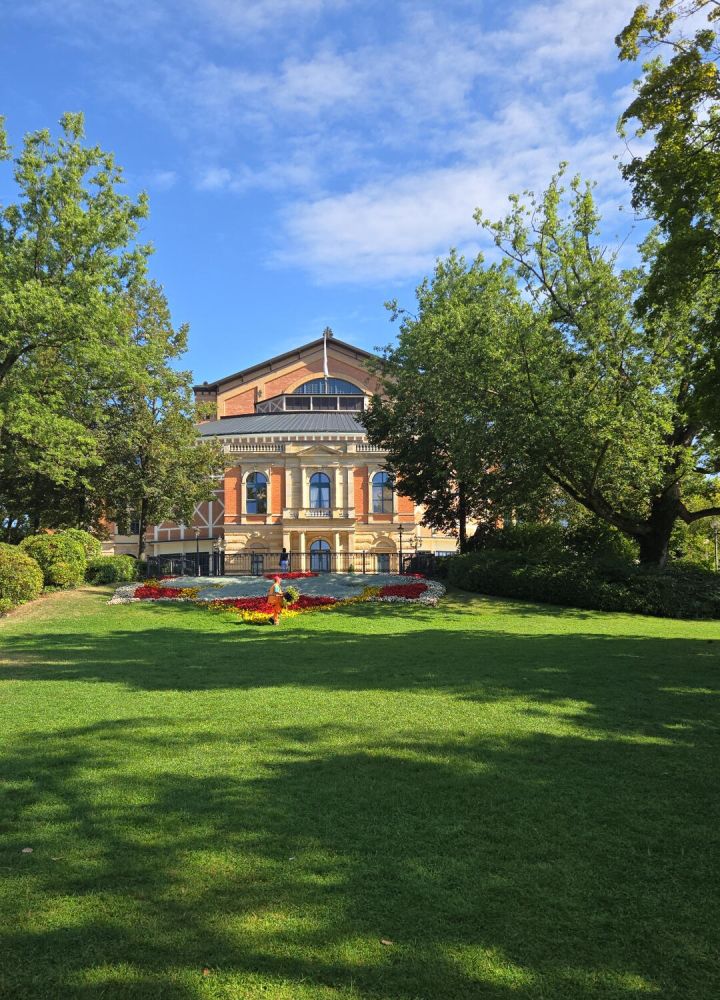
The Bayreuther Festspielhaus stands atop a green hill (photo by author)
[1] Jacques Le Goff, La naissance du Purgatoire (translated by Kaneo Watanabe and Hiroshi Uchida), Hosei University Press, 1988; Georges Duby, Le chevalier, la femme et le prêtre : le mariage dans la France féodale (translated by Katsuhide Shinoda), Shin Hyoron Publishing, 1984, and others.
[2] See, for example, The Middle Ages in Western Europe from the Perspective of "Sainthood": Saints, Relics, and Sanctuaries (Sogensha Inc., 2024).
[3] In the 20th century, French composer Olivier Messiaen composed the opera Saint François d'Assise. Lasting five and a half hours, the opera received its first full performance in Japan in 2017, presented by the Yomiuri Nippon Symphony Orchestra.
[4] While theologians from late antiquity asserted that the dead could not return to the realm of the living, by the medieval period, ghost stories became widespread both within and outside Church. For example, in Shakespeare's Hamlet, the ghost of the protagonist's father demands vengeance. This story is said to have its roots in medieval Norse legend. Medieval Icelandic sagas are also filled with tales of the undead. Clergy and monks of the Middle Ages often featured ghosts in moral tales, and such ghost narratives, though seemingly superstitious, came to be "accepted" by both Church and society. As a result, Western Christian culture came to embrace a rich diversity of beliefs and expressions. For instance, Verdi's Don Carlo(s) concludes with the appearance of the deceased emperor. See Jean-Claude Schmitt, Les revenants : les vivants et les morts dans la société médiévale (translated by Yoshiko Kobayashi), Misuzu Shobo Publishing, 2010, and others.
[5] At the Salzburger Festspiele held during the same period, I attended a performance of Mozart's La clemenza di Tito. The original story, which centers on an attempted coup in the Roman Empire, was reinterpreted through a contemporary lens as a tale of political strife in modern-day Italy. In this modern version, the music remained faithful to the original, with the notable features of Emperor Tito forgiving the conspirators and the opera concluding with cries of "Long live the Emperor!" However, the staging diverged significantly. In this modern version, amid the cheers, the Emperor (portrayed as a modern Prime Minister) is assassinated, after which the female ringleader of the coup takes his place. Seated in the Prime Minister's chair with her legs crossed, dressed in a suit, her pose uncannily resembled the appearance of Italy's current Prime Minister. This suggests either a pointed warning or a satirical commentary on the current political climate.
Taiichiro Sugizaki/Professor, Faculty of Letters, Chuo University
Areas of Specialization: Western Medieval History, Church History, and Veneration of Relics
Taiichiro Sugizaki was born in Tokyo in 1959. In 1983, he graduated from the Faculty of Humanities, Sophia University. In 1986, he completed the Master’s Program in the Graduate School of Humanities, Sophia University. In 1989, he completed the Doctoral Program in the Graduate School of Humanities, Sophia University. He received a Ph.D. in history from Sophia University in 1999. He served as a Full-Time Lecturer and Assistant Professor at Fuji Women’s Junior College before assuming his current position in 2000.
His research focuses on the relationship between the Church and society in the medieval West. He is currently analyzing historical sources related to rituals such as the veneration of relics and dedication ceremonies conducted at monasteries in southwestern France (the Languedoc region). He is also examining the process by which these monasteries, supported by secular communities, came to serve as regional “power spots” of spiritual and social influence.
His major publications include The Middle Ages in Western Europe from the Perspective of "Sainthood": Saints, Relics, and Sanctuaries (Sogensha Inc., 2024), History of Monasteries: From Saint Anthony to the Jesuits (Sogensha Inc., 2015), and more

