
2026.01.21
The Humanities and Digital Technology

- Takehiro Hashimoto
- Professor, Faculty of Global Informatics, Chuo University
Area of Specialization: English Literature
1. Relationship between the humanities and digital technology
When you hear the words "humanities" and "digital," you may feel as if something is amiss because these terms seem incompatible at first glance. However, in the world of research, humanities research using computers has a long history. For example, the field known as digital humanities is said to have begun in 1949 when Father Roberto Busa came up with the idea of using a computer to create a concordance of Thomas Aquinas.[1] Since then, humanities research centered on texts has fully embraced texts in the digital technology world through methods such as the creation of computer concordances, the digitization of texts that were printed or written on paper, and applications to the interpretation of literary texts through word frequency and visualization.
2. Digitalization of texts
Humanities research using computers can be roughly divided into two categories: the construction of digital archives and the analysis of texts. Currently, a wide variety of texts in a variety of languages have been digitized. For example, in the case of English literature alone, there are a variety of digitized texts, ranging from large-scale projects such as the Digital Public Library of America, Europeana, the HathiTrust Digital Library, Internet Archive, and Project Gutenberg, to specialized materials such as the Folger Shakespeare Library, the William Blake Archive, and the Shelley-Godwin Archive.[2] In Japan, various research institutions (including the National Museum of Japanese History, the National Institute of Japanese Literature, the National Institute for Japanese Language and Linguistics, the International Research Center for Japanese Studies, and the National Institutes for the Humanities) are digitizing and releasing humanities materials such as historical documents, maps, and videos.[3] The construction of digital archives in itself is an important research project. Moreover, the process has also led to the development of research that uses existing digital texts as primary sources, taking advantage of the wealth of digital texts that have been prepared so far.
3. Digital literary research
Let's look at an example of analytical research using digital texts in the field of English literature. In traditional literary research, a research method called close reading has been used as a common basic method even in more specialized fields of literary research. Close reading involves promoting new and deeper reading of a text by carefully reading the text and rigorously examining various questions and realizations that arise from the words, meanings and images of a text, and connections to other texts.[4] As an alternative to close reading, Franco Moretti has recently proposed distant reading, which is a new method of literary research using computers. Distant reading is a method of examining a large number of texts, including minor works and translations, and finding common trends throughout the texts.[5]
For example, let's consider the popularity of the Rubáiyát of Omar Khayyám, written by Edward Fitzgerald and based on the original work by Omar Khayyam. This selection of quatrains is said to have enjoyed immense popularity as an example of past Orientalism in English literature (not the concept of Orientalism sense following the works of Edward Said). In our analysis, we will look at the frequency with which the word "Rubáiyát" appears in published books. The process by which the Rubáiyát of Omar Khayyám reached high acclaim is said to be as follows: Fitzgerald discovered a Persian manuscript in 1856. He translated and published the manuscript in 1859, but initially sold no copies. The work gradually became popular and fashionable, and eventually became a massive hit after Fitzgerald's death in 1883. By the early 20th century, the Rubáiyát of Omar Khayyám was said to be one of the best-known collection of poems in the English-speaking world. In 1953, the Oxford English Dictionary cited lines of these poems 188 times, indicating its popularity; however, in 2009, the same poems were only quoted a few times.[6] As the extent of the work's popularity is somewhat unclear when examining only written sources, we will use the frequency of occurrence for the word "Rubáiyát" as an indicator of popularity. We used data from the HathiTrust Digital Library, which has a collection of 17 million books.[7]
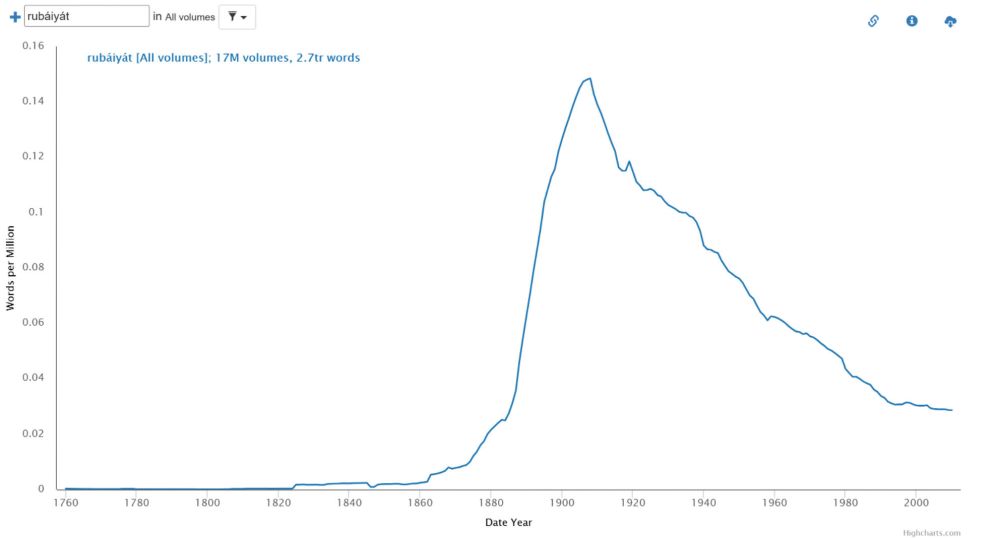
When visualizing the data, the low occurrence of phrases shows that the work did not sell well in 1859 immediately after publication. The subsequent increase shows a gradual rise in popularity. Afterwards, there was a sudden increase after Fitzgerald's death in 1883 until around 1908, indicating that the work had become a huge hit. We can also infer that it started to decline in subsequent years, but was still popular as of 1953. However, the current decline in popularity cannot be inferred from this graph.
HathiTrust's data is from books held in university libraries around the world. Accordingly, it is a collection of the kind of books gathered by university libraries. It is thought that HathiTrust does not include non-academic books that are in general circulation, so it is not an accurate measure of popularity. It also includes older books that were collected at a later point in time. Since the term "Rubáiyát" originally means quatrain poetry and many poets other than Omar Khayyám have written quatrain poetry, it is likely that HathiTrust's data includes words appearing in books written by other authors.
This type of distant reading like this will reveal new aspects of the Rubáiyát of Omar Khayyám. At the same time, it will give rise to further questions. Specifically, what was the reason for the rise in fame after the author's (Fitzgerald's) death? Also, why did the work decline in popularity after 1908? What did the term "Rubáiyát" refer to before Fitzgerald discovered the original manuscript in 1856? What factors were behind the temporary increase in popularity in 1919? Distant reading is a representative method for digital literary research; indeed, it can be said to be a method which excels at digital research.
4. Future of humanities and digital technology
Digital humanities, which is humanities research using computers, is a field that provides methods for various academic fields, a characteristic known as a "methodological commons."[8] In conjunction with the increased popularity of AI in recent years, participants at overseas conferences on digital humanities ask why not adopt large-scale language models when classical methods have been used. At overseas conferences on English literature, although special features on AI have been incorporated, careful consideration has been given to its bias, ethics, copyrights, and possibility of outputting errors. Some American universities have adopted digital humanities as a required course for the entire university or department, and there are discussions in regard to textbooks that can be used across universities and community colleges.[9] Digital texts will continue to increase in the future, and research and education using digital texts is also likely to increase. These trends may call for the need for common models of data, methods, and ways of thinking across various fields of research and education.
[1] Rockwell, Geoffrey and Stéfan Sinclair. Hermeneutica: Computer-Assisted Interpretation in the Humanities. The MIT Press, 2016. p.49.
[2] Digital Public Library of America. dp.la. Accessed 6 Mar. 2025. Europeana. The European Union. www.europeana.eu/en. Accessed 6 Mar. 2025. HathiTrust Digital Library. www.hathitrust.org. Accessed 6 Mar. 2025. Internet Archive. archive.org 1996. Accessed 6 Mar. 2025. Project Gutenberg. www.gutenberg.org. Accessed 6 Mar. 2025. Folger Shakespeare Library. www.folger.edu. 1996. Accessed 6 Mar. 2025. The William Blake Archive. www.blakearchive.org. Accessed 6 Mar. 2025. Shelley-Godwin Archive. shelleygodwinarchive.org/. Accessed 6 Mar. 2025.
[3] National Museum of Japanese History. www.rekihaku.ac.jp. Accessed March 6, 2025. National Institute of Japanese Literature. www.nijl.ac.jp. Accessed March 6, 2025. National Institute for Japanese Language and Linguistics. www.ninjal.ac.jp. Accessed March 6, 2025. International Research Center for Japanese Studies. www.nichibun.ac.jp/ja/. Accessed March 6, 2025. National Institutes for the Humanities. www.nihu.jp/ja/. Accessed March 6, 2025.
[4] The Princeton Encyclopedia of Poetry and Poetics. Edited by Roland Greene, et al, Fourth Edition, Princeton UP, 2012, p. 268. Terry Eagleton, What is Literature?, Vol. 1, translated by Ohashi, Y., Iwanami Shoten, 2014, pp. 115-119.
[5] Franco Moretti, Distant Reading, translated by Akikusa, S., et al. Misuzu Shobo, 2016. Afterword by translator Akikusa, S. for Distant Reading, written by Franco Moretti, pp. 324-339.
[6] Edward FitzGerald. Rubáiyát of Omar Khayyám: The Astronomer-Poet of Persia. Edited by Daniel Karlin. Oxford World Classics. Oxford UP, 2009, p. 1. Kuroyanagi, T., Persian Literary Thought, Kondo Publishing, 1977, pp. 117-122.
[7] HathiTrust Research Center. "HTRC Analytics." Bookworm β. Accessed 6 Mar. 2025. analytics. hathitrust.org/algorithms.
[8] Nagasaki, K., Methodological Commons: A Long-Established Standard in Digital Humanities, digitalnagasaki blog, December 20, 2020. Accessed March 6, 2025.digitalnagasaki.hatenablog.com/entry/2020/12/20/182659
[9] Fitzpatrick, Kathleen, et al., panelists. The (Im)Possibility of a DH Textbook. The 140th MLA Annual Convention, 12 Jan. 2025, Churchill A2, Hilton New Orleans Riverside Hotel, New Orleans, LA.
Takehiro Hashimoto/Professor, Faculty of Global Informatics, Chuo University
Area of Specialization: English Literature
Takehiro Hashimoto was born in Aichi Prefecture. He graduated from the Department of Middle Eastern Studies, Faculty of Foreign Studies, Tokyo University of Foreign Studies in 1997. He completed the Master’s Program in the Graduate School of Literature, Aoyama Gakuin University in 2001. He completed the Master’s Program in applied linguistics at the University of Melbourne in 2007. He completed the Doctoral Program in the Graduate School of Literature, Aoyama Gakuin University in 2009. He completed the Master’s Program in TESOL (Teaching English to Speakers of Other Languages) at Teachers College, Columbia University (Japan) in 2012. He served as a Full-Time Lecturer, Associate Professor, and Professor in the College of Economics, Kanto Gakuin University before assuming his current position in 2019.
His current research theme is the digital humanities influence of 19th century British Romantic poetry. (He is using digital humanities methods to study the poetry and influence of Coleridge, Wordsworth, and others poets, while also creating models, case studies, and platforms).

