
2026.01.14
Clues to Problem Solving Learned through Economics: Creating a Mechanism that Makes a Community Easier to Live in —Ninth Collaborative Course with “Otemachi Academia”—
- Daisuke Nakamura
- Professor, Faculty of Global Management, Chuo University
Areas of Specialization: Economics, urban and regional policies, space and location policies, etc.
Lecturer: Daisuke Nakamura/Professor, Faculty of Global Management, Chuo University
Areas of Specialization: Economics, urban and regional policies, space and location policies, etc.
Interviewer: Toru Takahashi/Chief Research Officer, Yomiuri Research Institute, Yomiuri Shimbun Tokyo Headquarters
Facilitator: Makoto Sekimizu/Yomiuri Research Organization
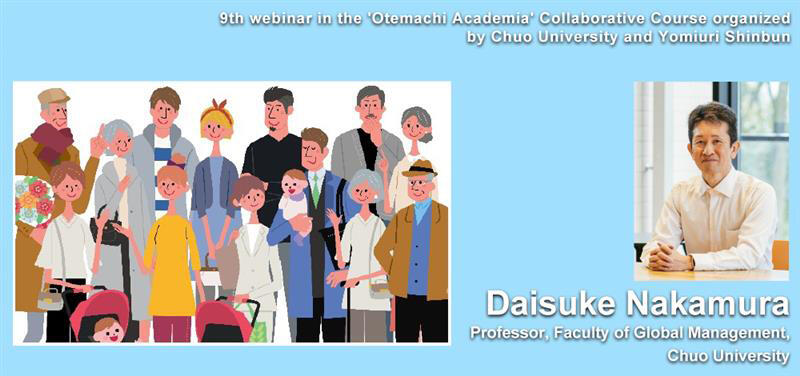
The ninth webinar in the Otemachi Academia collaborative course, which was organized jointly by Chuo University and the Yomiuri Newspaper to give back the invaluable knowledge cultivated by the university to society, took place on February 13. The webinar talked about how regional challenges should be addressed from an economic point of view. Professor Nakamura gave a lecture first, which was then followed by a talk session with Chief Research Officer Takahashi and a Q&A session.
Synergy between economic activities and community activities
The lecture started with the theme that personal relationships and bonds were weakening at the community level and people were becoming less interested in community activities, resulting in difficulties with sustainable community planning while our society was enjoying a high level of convenience thanks to the market economy. The lecturer proposed a way to resolve this challenge by applying the economics framework of location theory--in other words, the allocation of local resources--to construct a scenario to produce synergy between economic activities and community activities, because it could not be immediately addressed from the perspective of market mechanism.
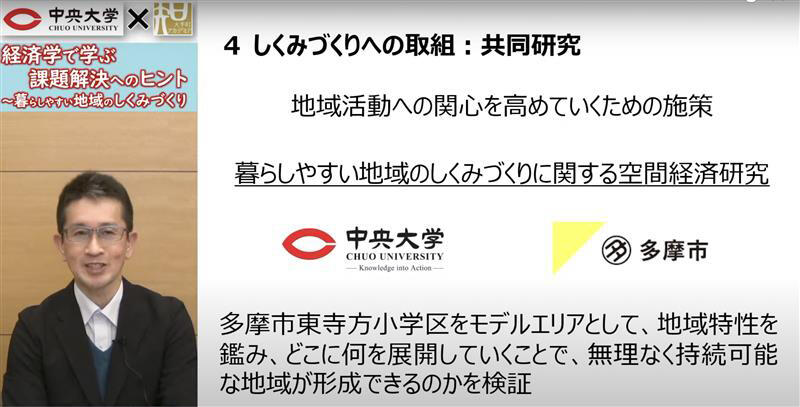
Chuo University and Tama City Government (Tokyo) have been jointly carrying out such research in the model area of the Higashi-Teragata Elementary School District since 2020. Consequently, a support system for community activities has been gradually introduced through a new office named Collaborative Creation Promotion Office in Tama City. The Higashi-Teragata Elementary School District is an area with a population of about 23,000 people, with the closest station being Seiseki-sakuragaoka Station (Keio Line). This marks the fifth year of the joint research project, which began by conducting a resident questionnaire survey to narrow down local characteristics and challenges. The project has enabled residents (mainly those who gave their contact information when submitting their questionnaire responses) to have repeated discussions through a workshop called "Area Meeting" held three times a year.
The Area Meeting has led to the launch of a number of Mini Projects, which are community activities spearheaded by residents themselves, resulting in the start of reasonable, sustainable activities. The Music & Culture group organizes activities most actively, such as mini-concerts played by locally based violinists, pianists, and ukulele players. Meanwhile, the Sports & Play group has held themed cleanups along the river, Oguri-gawa, with local children, and the Nature & Environment group has conducted safety checks along the school routes and hosted tours to allow the locals to rediscover the rich nature in the area. A new program named "Co-Creation Meeting" has also been launched this year. It connects existing community action groups, including neighborhood associations and mediators' associations, and those who have long been involved in the Area Meeting,
The key to long-lasting activities is feeling greater fulfillment than burden
There are participants of these activities who say that they can find greater fulfillment than burden. As long as participation in activities provides them with net benefit--in other words, it produces net positive effects--we can expect community members to take part as well. This is the reason that one of the Mini Projects, "Community Study Session," launched the "Terakoya" project in FY2024 to provide a readily accessible gateway for new people to join.
Some also argue that the important thing is to provide opportunities, not only to learn but also to improve work and negotiation skills and receive advice about everyday issues, and that the organic formation of community support networks should automatically result in community support becoming more available to members. They say that when the number of participants increases, a virtuous cycle of what is known as "comparative advantages" in economics terms will follow, because there will be a wider variety of ideas and more things that they can do, and it will become easier for participants to take advantage of their own strengths.
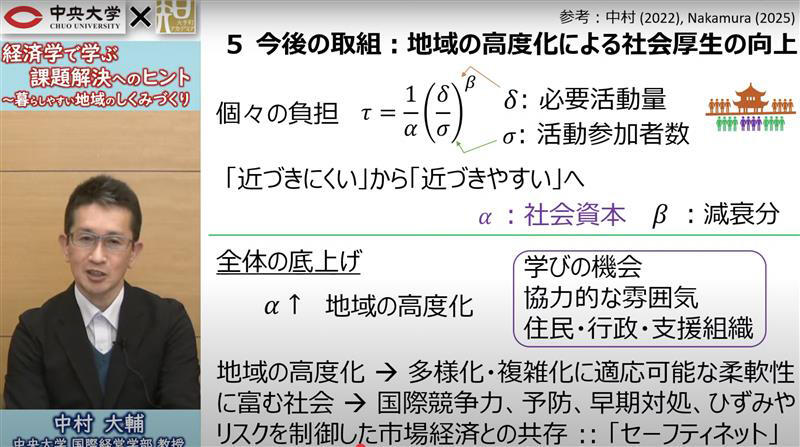
At the present stage, the series of initiatives implemented as part of the joint research project are considered to have reached the introduction phase for the creation of a sustainable community mechanism. The future theme will be the advancement of the community. The advancement of the community is also formally represented in a simplified expression. If the burden borne by individual community members is expressed in a fraction and is compared to a mikoshi (a portable Shinto shrine carried on the shoulders of festival participants), the numerator represents the weight of the mikoshi (required amount of activity δ) and the denominator represents the number of participants carrying the mikoshi (number of participants σ). Once an atmosphere that encourages helpers, who are boosters (α), to join the denominator is created, the burden shouldered by each participant will become lighter. Furthermore, if there are local human resources with sports experience who can introduce stretching and other health programs to community members, those who have been supported on the numerator side can move to the denominator side. When this happens, α will grow more and more to enhance the overall level, leading to further advancement of the community. A more advancement community can respond more flexibly to various changes in modern society, can prevent the damage caused by natural disasters and other risks, and can deal with them faster. This allows the community to support and stay in harmony with the market economy, which cannot make instant responses.
In summarizing his lecture, Professor Nakamura also argued as follows: Some say that we can lead a good enough life as long as the market mechanism works well and public services are available to us. However, imagine you are living in an environment where you have people who you feel safe with and can count on in normal times. If a situation arises that forces you to live in an emergency shelter, for example, the feeling of not knowing anyone versus feeling relieved that you know someone can make a difference. Furthermore, if you need to deal with an unexpected situation, there is also a big difference if you have to make decisions on your own with no one around to turn to or if you have someone to turn to for help. When personal bonds have been forged in a community, it is expected to help community members to deal with their problems.
The university's intervention for effective utilization of local resources
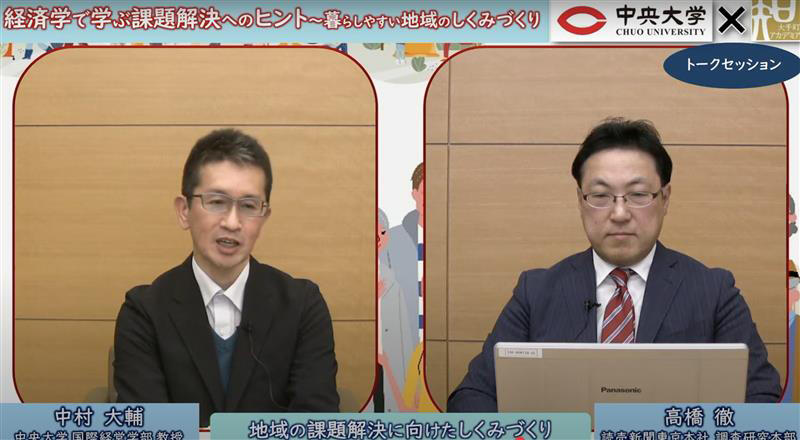
The lecture was followed by a talk session, in which Chief Research Officer Takahashi asked questions, such as the local resources seen from the perspective of the location theory, approaches to local community development, and the goals of the joint research with Tama City in Tokyo, as he summed up the key points of the lecture, and the two discussed the matters. Regarding approaches to local community development, Professor Nakamura answered a question about the initiatives implemented as part of the joint research with Tama City to achieve local community revitalization and argued, "The important thing is to create problem-solving programs through resident-led efforts and build connections to existing community action groups, including neighborhood associations," while referring to community development examples in a new town in Fukuoka called "Fukuoka Island City." In response to the question about the goals of the joint research with Tama City, he answered, "The university will intervene with administrative authorities and local residents as an intermediary support organization to help create a mechanism for reasonable, effective utilization of local resources (such as community action groups, facilities, equipment, etc.)." In closing, Chief Research Officer Takahashi summarized as follows: "The case study in Tama City has revealed that the key to local community revitalization lies in lowering barriers to entry by reducing the psychological burden on residents."
In the Q&A session, participants asked many questions. In response to a question concerning how to take the first step towards community activities, Professor Nakamura answered, "It is necessary to create a mechanism for easier entry. It would be great if administrative authorities, the university, and community support organizations could act as some kind of cushion to narrow the difference between what is expected of community action groups and what new prospective participants can do." There was also a question asking, "What about the problem of overtourism in the Tama area, which has real-life locations that have inspired Studio Ghibli movies and attracts numerous 'pilgrimage' tourists?" He answered, "While those neighborhoods are responding favorably to tourists at present, some tourist sites independently send a strong message to tourists demanding them to help preserve their sites in good conditions," citing Itoshima City in Fukuoka as an example.
* Click here for the video of the ninth collaborative course with Otemachi Academia on February 13, 2025, titled "Clues to Problem Solving Learned through Economics: Creating a Mechanism that Makes a Community Easier to Live in."
Clues to Problem Solving Learned through Economics: Creating a Mechanism that Makes a Community Easier to Live in.
Daisuke Nakamura/Professor, Faculty of Global Management, Chuo University
Areas of Specialization: Economics, urban and regional policies, space and location policies, etc.
In 2006, Daisuke Nakamura received a doctorate (Ph.D.) from the University of Glasgow, UK, under the guidance of Professor J.B. Parr. He served as Visiting Scholar of the Regional Economics Applications Laboratory at the University of Illinois in the United States, which is led by Professor Geoffrey J. D. Hewings, until 2008. He also served as a Full-time Instructor at the Northern Catholic University in the Republic of Chile before returning to Japan in 2010. Afterwards, he served as Senior Researcher at the International Centre for the Study of East Asian Development in Kitakyushu City and as a Visiting Associate Professor in the Graduate School of Economics, Kyushu University until 2013. He served as Associate Professor and Deputy Director of the Preparation Office of the Women’s Leadership Center of Fukuoka Women’s University until 2019. He assumed his current position in April 2019.
His area of expertise is Location Economics. His current research theme is sustainable regional economies and ease of living under limited resources. His most recently published papers include: Nakamura D (2022), A cooperative regional economic system for sustainable resilience policy, Applied Spatial Analysis and Policy, DOI: 10.1007/s12061-022-09443-5.
He currently holds various positions, including Secretary of the Spatial System Research Unit of the Institute of Economic Research, Chuo University, Representative of the model area project joint research with the Planning Division of the Planning and Policy Department of Tama City, and a member of the Hachioji City Urban Development Master Plan Revision Council.

