
国際経営学部
[Faculty of Global Management] On 13 November 2026, prof. Nguyen Dinh Tuan Vuong from the University of Tsukuba gave guest speaker lecture in Seminar 1
2026年11月16日
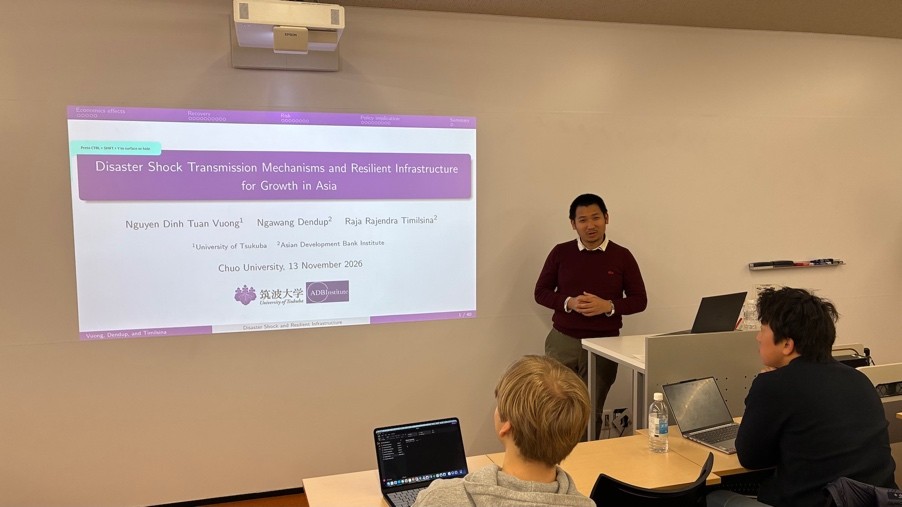
On 13 November 2026, we welcomed professor Nguyen Dinh Tuan Vuong of the Institute of Humanities and Social Sciences, University of Tsukuba, as a guest speaker in one of our Seminar 1. Professor Vuong holds a PhD in Agricultural and Applied Economics from the University of Wisconsin–Madison and an MA in Economics from the University of Maine. His research covers development and labor economics in Southeast Asia, including foreign investment, labor markets, schooling and the economic effects of environmental disasters. His talk drew on a chapter he is writing with Ngawang Dendup and Raja Rajendra Timilsina of the Asian Development Bank Institute for the book Disaster Shock Transmission Mechanisms and Resilient Infrastructure for Growth in Asia.
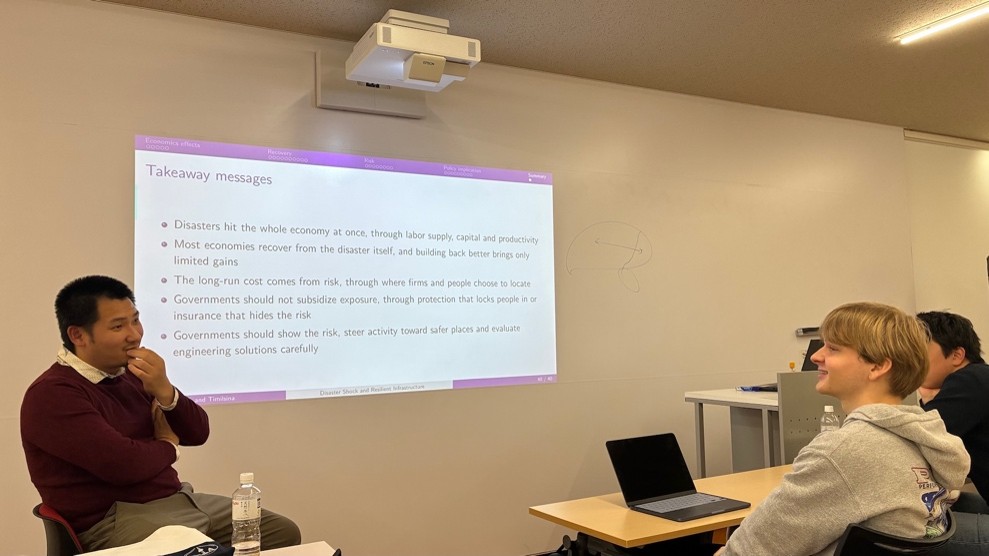
Professor Vuong explained how natural disasters hit economies through labor, capital, productivity and supply chains, and why most economies recover. He showed that much of the long-run cost comes from the risk of disasters, because risk shapes where firms and people choose to locate. Speaking to students as future policymakers, he warned against protection and underpriced insurance that keep activity in harm’s way. He argued instead for making risk visible and steering development toward safer ground.
In the discussion, we learned that good disaster data turns uncertain threats into expected costs that firms and governments can plan around.
Firms can use it to choose safer locations and suppliers. Governments can use it to weigh infrastructure options against their costs and benefits. Students noted this matters most in developing countries, where hazard maps are often missing and decisions are made without seeing the risk.
