
国際経営学部
[Faculty of Global Management] On May 18th, dr. Utsumi Tomoko of Soka University delivered a guest lecture at the Introductory Economics class
2026年05月26日
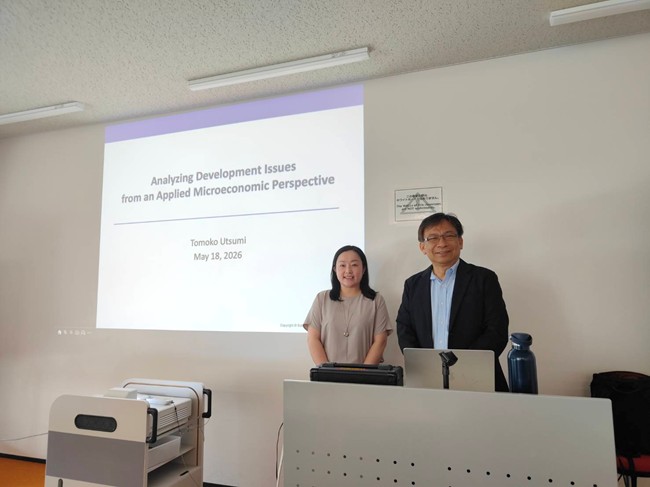
Dr. Utsumi Tomoko of Soka University delivered a guest lecture titled Analyzing Development Issues from an Applied Microeconomic Perspective on May 18, 2026 during the Introductory Economics class (instructor: George Wang).
Dr. Utsumi specializes in development economics and introduced students to the study of social and economic issues affecting low- and middle-income countries. Her lecture focused on how microeconomic analysis and behavioral economics can help researchers and policymakers better understand individual decision-making and design more effective policies to address poverty, health, education, savings, and inequality. Through accessible examples and interactive questions, she encouraged students to think critically about the relationship between economic theory and real-world human behavior.
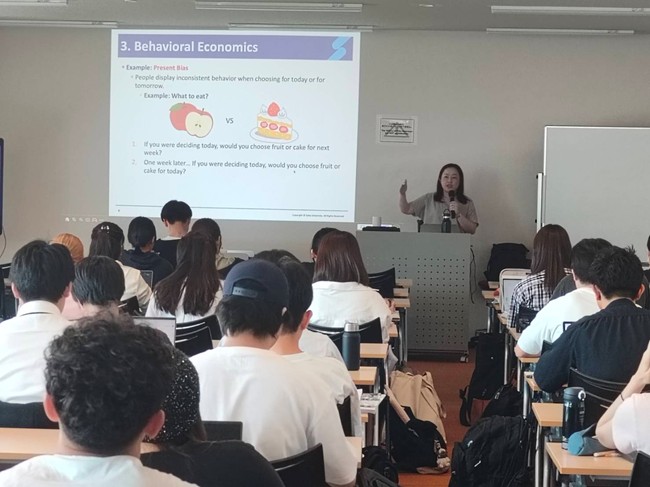
In the first part of the lecture, Dr. Utsumi explained the importance of examining development issues from a microeconomic and behavioral perspective. She contrasted traditional “top-down” development planning with more bottom-up approaches that focus on the actual needs and behavior of individuals. Introducing the concept of behavioral economics, she discussed how people do not always behave as rationally as standard economic models assume.
Using examples such as procrastination and “present bias,” she demonstrated how individuals often prioritize immediate gratification over long-term benefits, even when doing so may make them worse off in the future. Dr. Utsumi then applied these ideas to public health issues in developing countries, explaining why inexpensive and effective preventive measures—such as vaccinations, clean water treatment, oral rehydration solutions, and malaria-prevention bednets—are often underutilized. She highlighted how behavioral tendencies and small psychological costs can discourage people from taking beneficial health actions, and discussed policy tools such as incentives, opt-in and opt-out systems, and information campaigns to encourage healthier behavior.
The second part of the lecture focused on savings behavior among low-income households and the challenges faced by the poor in managing finances. Dr. Utsumi explained that although many poor households lack access to formal banking systems, they still save through informal methods such as storing money at home, saving through goods or livestock, or participating in community-based savings groups. She discussed how present bias and self-control problems can make saving difficult, especially when individuals are tempted to postpone saving or withdraw money prematurely. As an example of a practical solution, she introduced ROSCAs (Rotating Savings and Credit Associations), in which community members contribute regularly and take turns receiving lump-sum payments. Drawing on evidence from development studies, she showed how such systems can help individuals overcome behavioral barriers to saving. Dr. Utsumi concluded by emphasizing that behavioral economics provides valuable insights into human decision-making and can contribute to more effective development policies and interventions in areas such as health, finance, and poverty reduction.
