
国際経営学部
[Faculty of Global Management] Dr. Alex Chan from Soka University gave a special lecture at the Microeconomics class
2026年05月27日
Dr. Alex Chan of Soka University delivered a guest lecture on poverty and social welfare issues among older adults, with a particular focus on the situation in Hong Kong. The lecture took place at the Microeconomics course (instructor: George Wang).
Drawing on research in social policy, aging, and welfare systems, Dr. Chan introduced students to the challenges faced by aging societies and the difficulties governments encounter in designing effective retirement protection and anti-poverty measures. His lecture combined statistical analysis, policy discussion, and comparative perspectives to help students understand the economic and social vulnerabilities experienced by elderly populations in rapidly developing urban societies.
In the first part of the lecture, Dr. Chan explained different approaches to measuring poverty among older adults and discussed the limitations of relying solely on income-based indicators. Using research data from Hong Kong, he demonstrated how some elderly individuals may appear poor in terms of monthly income while still possessing significant assets or savings, making them “asset rich but cash poor.” He compared relative poverty measures, such as using half of median household income, with absolute poverty measures linked to government welfare thresholds. The lecture also examined Hong Kong’s retirement protection system, including the Comprehensive Social Security Assistance (CSSA) program, Old Age Allowance schemes, and the Mandatory Provident Fund (MPF) system. Dr. Chan emphasized that the existing welfare structure in Hong Kong remains underdeveloped and strongly influenced by a neo-liberal policy orientation that limits redistributive social welfare programs.
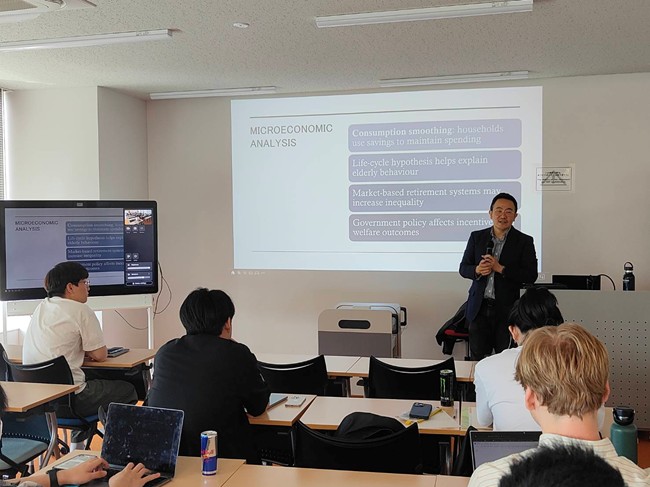
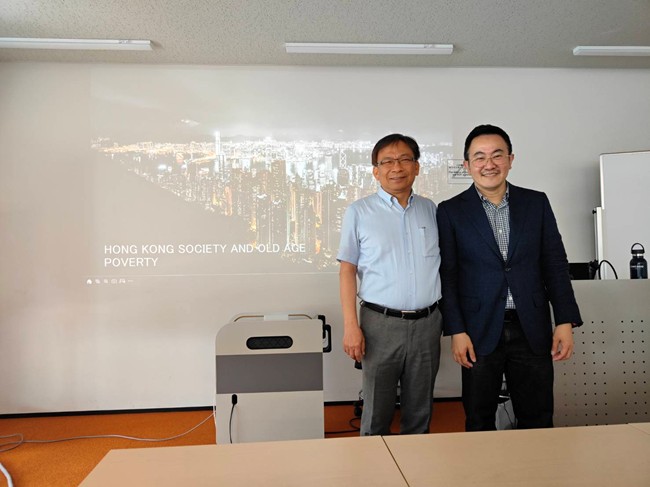
The second part of the lecture focused on the demographic and social characteristics associated with old-age poverty. Dr. Chan presented findings showing that poverty risks increase with age, particularly when consumption-based measures are considered alongside income measures. He highlighted that women, widowed individuals, and elderly people living alone are especially vulnerable to poverty, reflecting broader issues such as the feminization of poverty and weakening family support structures in aging societies. Through comparisons with studies conducted in the United States and China, he illustrated how differences in pension systems and welfare policies can significantly affect the living standards of older adults. Dr. Chan concluded that combining both income and consumption measures provides a more accurate understanding of poverty among the elderly and argued that policymakers need more comprehensive and compassionate welfare policies to address the growing economic insecurity faced by aging populations in Hong Kong and other societies.
