
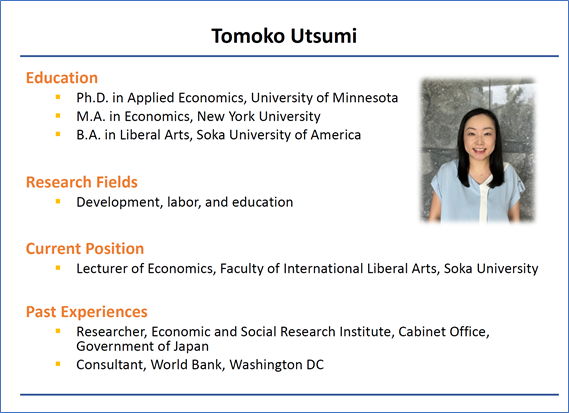
Dr. Tomoko Utsumi is a distinguished scholar who serves as Associate Dean and Associate Professor at the Faculty of International Liberal Arts at Soka University. She holds a Ph.D. in Applied Economics from the University of Minnesota, an M.A. in Economics from New York University, and a B.A. in Liberal Arts from Soka University of America. Over the course of her career, Dr. Utsumi has contributed her expertise to several leading institutions, including the World Bank, MIT’s Abdul Latif Jameel Poverty Action Lab (J-PAL), and the Economic and Social Research Institute of Japan’s Cabinet Office.
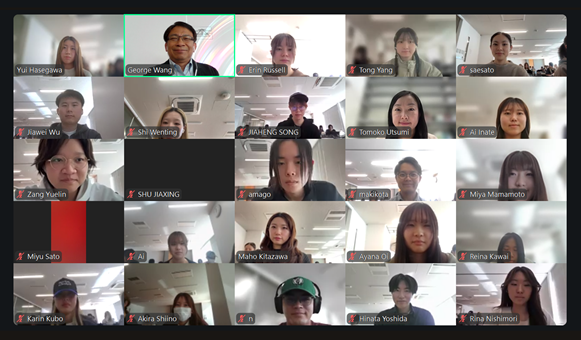
The guest speech was originally scheduled to be delivered in person. However, due to a last-minute notice just a few days beforehand requiring Dr. Utsumi’s attendance at an administrative meeting, the session was ultimately conducted via Zoom.
Today’s lecture examines development issues through an applied microeconomic lens, focusing on how individuals in low- and middle-income countries make decisions under constraints. Traditional development approaches often rely on top-down planning, but the microeconomic perspective emphasizes a bottom-up understanding of real behaviors, needs, and frictions. As highlighted in the contrast between “planners” and “searchers,” effective development work requires identifying practical solutions that address individuals’ lived realities rather than assuming that large-scale strategies will translate smoothly to the ground.
A key part of this bottom-up approach involves incorporating insights from behavioral economics, which recognizes that people are not always fully rational or perfectly informed. Human behavior frequently deviates from standard economic assumptions—people procrastinate, favor immediate gratification, or avoid small hassles even when future benefits are large. This present bias helps explain why proven, low-cost health technologies such as vaccines, water purification, or deworming pills remain underutilized. Policies that reduce immediate costs or make healthy actions automatic—for example, small incentives or opt-out systems—can significantly increase uptake and improve health outcomes.
The same behavioral frictions appear in savings behavior among the poor. Despite low incomes, many households save through informal mechanisms such as hiding money, buying livestock, or participating in rotating savings groups. Present bias and self-control challenges make it difficult to consistently set aside or keep savings, and these barriers can be stronger for the poor, who face more frequent shocks and temptations. Innovations like ROSCAs help individuals commit to saving by creating social pressure and structure. Overall, integrating behavioral insights into development economics leads to more realistic policies—ones that acknowledge the psychological constraints people face and design environments that help them make choices aligned with their long-term well-being.
