
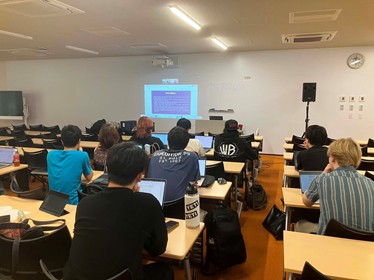
On July 9th, Dr. Amro Aljbour from the Queensland University of Technology and the University of Queensland in Australia delivered an online lecture titled “Talent Management” This lecture is based on his PhD research and published academic articles. It is part of the Strategic Management course tutored by Professor Tsuyoshi, Kimura and Assistant Professor Toyohiko Sugimoto at GLOMAC.
Dr Aljbour, a Senior Research Assistant and Sessional Academic at QUT Business School, Queensland University of Technology and UQ Business School, The University of Queensland. He earned his Ph.D. in talent management from Queensland University of Technology in 2024.
He is a leading young scholar in the field of talent management research with multiple publications in leading academic journals, such as Human Resource Development Quarterly, International Journal of Productivity and Performance Management, and Employee Relations. He also holds a strong practical background in related areas. He works as a Senior Research Assistant and Sessional Academic at several leading universities worldwide. He has delivered corporate training to over 3,500 participants across more than 100 organisations in Jordan, Australia, and the Gulf region. His training sessions cover topics such as team building, talent management, personality types, and communication skills.
Dr Aljbour’s guest presentation consisted of two parts. First, he explained how business strategy is relevant to strategic human resource management and how his research topic, talent management, relates to and is situated within the context of management research. He described the connection between competitive advantage and strategic human resource management, noting that talent management practices can ultimately generate this advantage.
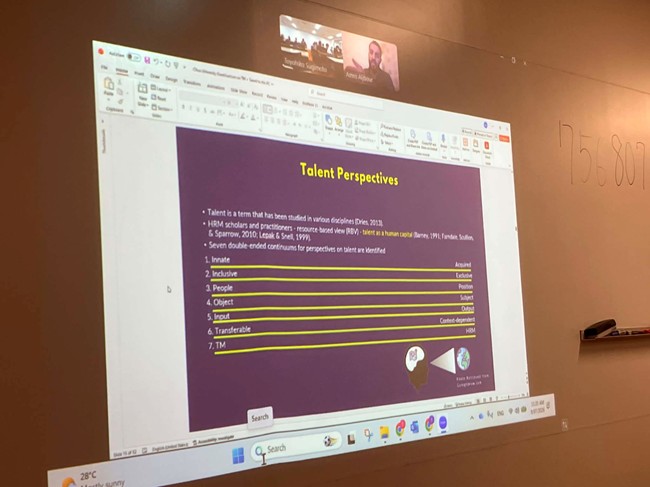
In the second part of his presentation, He specifically focused on his research topic, talent management, and provided the recent academic findings related to this topic, such as firms’ approaches to recruit and retain talent from the perspectives of key people, strategy, practices and positions. Especially, to effectively manage talent in organisations, he emphasized the importance of a consistent evaluation policy that is well communicated throughout the organisation. Employees should be evaluated not only on their current performance but also on their future potential, which is characterized by a flexible mindset.
During his guest lecture, the students maintained high concentration and actively engaged during the Q&A session. They actively asked 5-6 questions, and surprisingly, most of them were quite specific, including:
“How would talent management practices vary across different cultures? How should international corporations handle such differences?”
“What steps should we take to secure a talent management position in a corporation? Should we focus on building a relatively long-term career in a single firm, gaining business knowledge, and then moving into talent management later?”
“How can recruiters recognize and judge if an applicant or employee is a talented businessperson?”
“Would it be beneficial to learn psychology for working in the field of talent management?”
This could be due to his research topic being highly topical in the field of management research, as well as from an industry perspective, making it particularly interesting for GLOMAC students. He also kindly designed and delivered his presentation in a student-friendly manner by associating key terms from his presentation, such as competitive advantage, product leadership, and human capital, with concepts that have been discussed in previous lectures and tutorials.
Overall, his presentation provided a valuable learning opportunity for GLOMAC students, allowing them to deepen their knowledge relevant to the lecture content and gain important research insights.
